

2026 Exhibitions

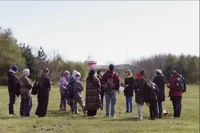
Sensing energy transition
This exhibition explored how people experience the sounds, textures, and atmospheres of energy transition. The exhibition showcases work from Living with Energy Transition, a collaborative project focused on a series of public soundwalks by artist Maja Zećo. The soundwalks focused on St. Fittick’s Park in Torry, Aberdeen – a site partially earmarked for development as an energy transition zone. Sound walking is a practice of listening while walking. Each walk was an artwork involving careful attention to the park and its human and nonhuman inhabitants. Participants followed specific routes that drew attention to the diverse sounds emanating from different features around the park and travelling across it.
This exhibition was organised by LSE Anthropology in association with LSE Arts and funding from the LSE Engagement and Partnerships Fund.

A beaver's tale: 130 years of campus, culture and conservation
From the School crest and the SU newspaper to a capering mascot at Welcome and Graduation, LSE’s beaver is intertwined with our history and continues to drive our community spirit. Celebrating LSE’s 130th anniversary, this exhibition took visitors through LSE’s archives to tell our beaver’s tale, from first appearances to recent conversation efforts. The exhibition documented how our mascot was chosen, displayed archival copies of The Beaver newspaper, and explored how we’re continuing to partner with local projects to conserve beaver populations in London for future generations.
A beaver's tale: 130 years of campus, culture and conservation was curated by Olivia Broome (LSE Communications), Clara Rawlings (LSE Communications), Beatrice Clementel (LSE Sustainability), Hannah Liu (LSE Arts), and Lucas Ngai (The Beaver) in association with LSE Arts.
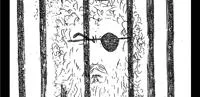
Art from Guantánamo
This exhibition displays the work of Abu Zubaydah, a 55-year-old Palestinian who has been detained in Guantánamo Bay for 24 years. In the aftermath of 9/11, he was secretly held and brutally tortured by the CIA, with the complicity of many states, including the UK. He is dubbed the “forever prisoner” as the US claims the right to continue to detain him without any such charge or trial for the remainder of his life. Many facts surrounding that torture and complicity remain classified, and his conditions of confinement at Guantánamo mean that he is not allowed to communicate with the outside world. In this exhibition, he speaks through his art, giving graphic insight into his experience. His work depicts the impact of the “extraordinary interrogation techniques” inflicted by the CIA with approval from the highest level of the US government. It urges us to reflect, learn and act to end torture, arbitrary detention and the inhumanity of Guantánamo.
This exhibition is organised by LSE Law School in collaboration with Human Rights in Practice and Human Rights in the Picture, in association with LSE Arts. The exhibition forms part of a project focused on exposing and ending Abu Zubaydah's ordeal.
Change is human work: sustainability at LSE
This exhibition explores sustainability as a lived, collective practice shaped by the people within the School. Through portraits of staff and students, behavioural change campaigns, and archival materials, it highlights the often-unseen everyday efforts ranging from teaching and research to resource use and campus care that sustains the institution. By connecting present actions with historical environmental movements, the exhibition shows how sustainability evolves over time while remaining rooted in individual and shared responsibility. Ultimately, it presents sustainability not as an abstract idea, but as ongoing human work expressed through daily decisions and collective commitment.
This exhibition was organised by Beatrice Clementel, Sustainability Communications & Engagement Officer at LSE as part of the LSE Festival 2026: How to save the planet.