

Dr Benjamin Braun co-authors report on economic democracy for Spanish government
Article 129.2 of the Spanish Constitution promises democracy at work via access to voice and access to ownership. Since February 2025, the International High-Level Expert Committee on Democracy at Work, an expert group convened by the Vice President and Minister of Labour of Spain, Yolanda Díaz, and the Secretary of State for Employment, Joaquín Perez Rey, has been researching how to make good on that promise.
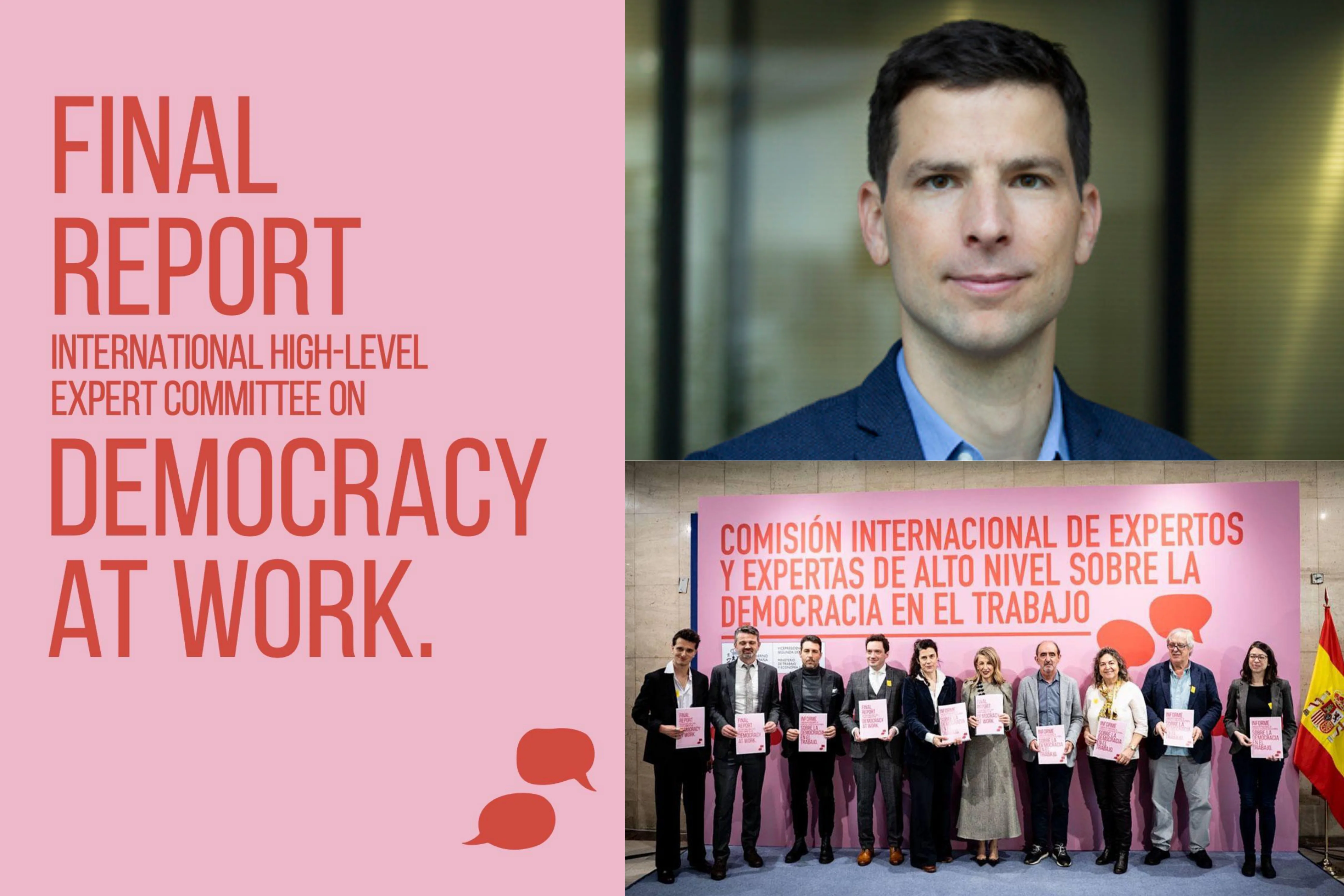
For the past year, our Assistant Professor in Political Economy Dr Benjamin Braun has been on the International High-Level Expert Committee on Democracy at Work, a commission of thirteen members presided over by Professor Isabelle Ferreras. The results of the study were officially announced this week by the Spanish Labour Minister Yolanda Díaz in Madrid, where the final report was launched.
Led by the amazing Isabelle Ferreras, we have delivered what may well be the highest-level 400-page report on economic democracy out there. It's been a privilege to be working on something so ambitious and hope-inspiring. A lot of deep thinking and research have gone into this report, and the dedication of everyone on the commission really shows in the final product.
We encourage you to explore the study's official website to discover the Committee's full report, the recording of the launch event in Madrid, a documentary, as well as press clippings. Moreover, Professor Isabelle Ferreras will be speaking on an upcoming panel alongside our ESRC Postdoctoral Fellow Neil Warner at the upcoming Ralph Miliband Programme LSE event, "Is a democratic economy possible? Lessons from history, horizons for the future," on 30 March 2026.
Executive Summary
"Despite remarkable achievements in recent years—most notably a multi-dimensional labour market reform that reduced unemployment and fuelled economic growth, positioning Spain as a leading economy within the EU—the Spanish Government aims even higher. Indeed, the Constitution itself calls for greater ambition.
The Expert Committee was tasked with examining the application of Article 129.2 of the Spanish Constitution as a potential remedy for the situation of polycrisis faced by Spain and all of the world’s nations, marked by increasing economic and social inequality and the depletion of natural resources, which threatens a sustainable future for all.
The work of the Expert Committee was divided into 3 mandates:
- Diagnosis: Examine the history, content, and current applications of Article 129.2, and identify contemporary problems for which its application might offer solutions.
- Strategy: Propose a trajectory for the application of Article 129.2 moving forward.
- Policy: Identify legislative tools and other resources that offer rigorous, research-based solutions that are innovative, economical, and adaptable to Spain’s culture of territorial and economic diversity.
Article 129.2 makes a dual promise to all workers in Spain: access to voice and access to ownership. The Expert study concluded that Article 129.2 is not currently being applied through effective legislation. Indeed, Spain is among the least developed countries in the European Union in terms of the recognition of workers as key constituents of the economy, measured both in terms of institutional structures that allow for democratic participation in the workplace and in terms of worker access to ownership of shares in companies.
At the same time, the Committee also observed a number of Spanish enterprises that model exemplary applications of Article 129.2, notably worker cooperatives, which are some of the strongest in the world. Committee members concurred that a more rigorous application of Article 129.2 could prove to be highly effective in helping Spain to join the leaders of the EU in terms of best practice, and to move up the productivity ladder identified as the key challenge of the European Union by the Draghi Report (2024).
In specific, the Committee recommended firm democratization as a means of enacting the mandates of Article 129.2 by opening a path for all labour investors to access voice and ownership, and marshalled factual evidence and robust economic and political arguments to explain the necessity of public intervention in this direction."
Discover the full report