

BLOG: Government Innovation at Glasgow City Council
Written by Estelle Broyer.
This blog is part of our series on LSE Cities' Deep Dives into City Government Innovation across Europe. In our first blog, 'A new approach to understanding how cities innovate - Inside city halls', we described our in-depth, qualitative and participatory approach to research, which aims to generate insights into how city governments build and sustain their capacity to solve complex urban problems innovatively. Glasgow City Council is one of three European city governments that LSE Cities is working with during the first year of this project.
Through working with Glasgow City Council, we've learned that not all government innovation is immediately visible from the outside. Political and fiscal constraints may force city councils to compromise and look for innovative approaches they can cultivate within their organisation, becoming creative with the few levers at their disposal. Working around its central mission of reducing child poverty, fundamental if not easily marketable, Glasgow City Council is attempting a profound shift in how municipal staff envision their roles, which they hope will lead to many small but coherent and impactful changes.
This blog is the first of several discussing our qualitative research in Glasgow.
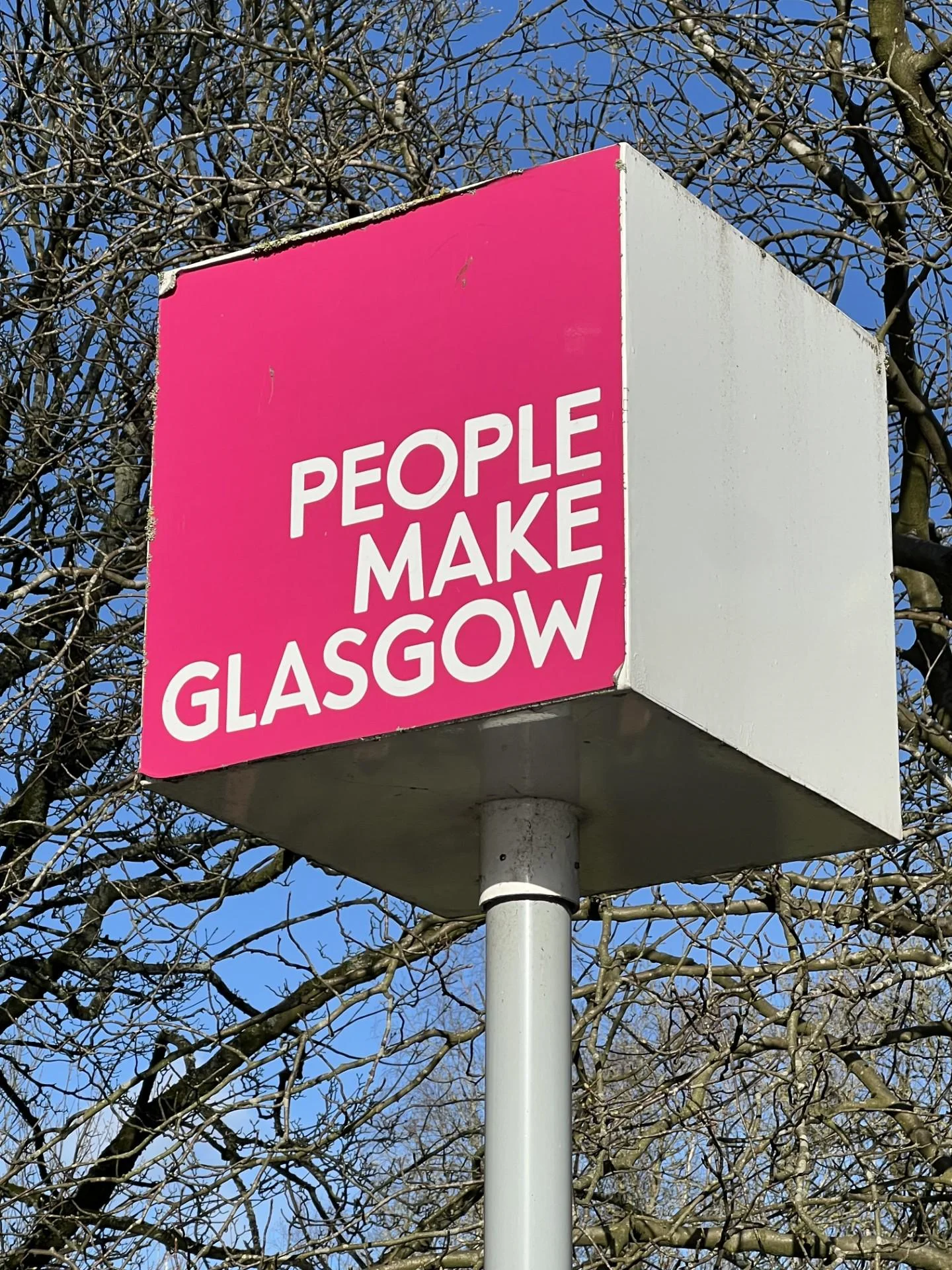
"People make Glasgow" is the official slogan of the city – but is it more than just a marketing exercise? Photo credit: Estelle Broyer
Reducing child poverty; a uniting 'grand challenge'
Glasgow is no stranger to economic inequality. As a 'powerhouse' of the British empire in the 18th and 19th centuries, Scotland's largest city offered riches and cultural confidence to some, but overcrowding, ill-health and insecure work to many. The rapid loss of manufacturing jobs from the 1950s onwards only deepened this gap, as its poorest households bore the heaviest, multigenerational cost of economic distress.
Today, this challenge is different in form but familiar in substance: growth and recovery have not reached all parts of the city equally. Since the 2008 financial crisis and the COVID lockdowns, many young people, low-income households, and less qualified workers have struggled to benefit from new opportunities. The task for the council is therefore not simply to grow the economy, but to widen access to work, support, and opportunity while reducing pressure on communities facing poverty and exclusion.
Glasgow City Council's Strategic Plan identifies reducing poverty and inequality—and especially child poverty—as one of four central missions alongside creating opportunity, enabling fair climate action, and reforming services. This focus represents the kind of government innovation the Deep Dives research team of the Bloomberg LSE European City Leadership Initiative at LSE Cities has set out to explore: innovation that is not necessarily 'shiny' but that aims to change lives through new approaches and priorities.
In the 1980s, the council had cleaned soot-blackened stone buildings. In the following decades, it marketed Glasgow as a Creative City of Music and European Capital of Culture, redeveloped major sites, hosted the Commonwealth Games and COP26, and promoted new Innovation Districts. The council still values the opportunities that outward displays of entrepreneurialism afford. Yet these are now second to the harder (and deceptively quiet) work of looking inward in pursuit of a shared mission. To us, this is the most interesting shift at Glasgow City Council.
Looking beyond structural constraints
The search for a mission around which to rally may be a response to Glasgow's political reality. Since 2017, Glasgow City Council has been led by the Scottish National Party (SNP)—Scotland's centre-left social democratic party—in a minority administration. Its indirectly elected Leader, unable to impose its policy programme unopposed, must build and sustain support across parties and committees. While arguably more democratic, this governance model also forces the leading party to pick its battles (and perhaps more positively, to be crystal clear on its priorities). A mission such as reducing child poverty may therefore be practically useful as well as morally compelling: it creates a common purpose around which councillors, officers, and partners can align.
Resource constraints – the Council’s budget is shrinking and its powers are limited by European standards – are also forcing the council to be pragmatic and to prioritise incremental and community-scaled initiatives over Grands Projets. Yet these constraints might be exactly what triggers creativity, pushing the council to innovate out of necessity but transforming the organisation and its outcomes in fundamental ways in the process. We will have to see how the new devolution of powers and funds to cities and city regions, under new UK Prime Minister Andy Burnham, will modify these parameters.
Forging a new culture of government innovation
The deeper question for now is how the political mission of reducing poverty changes the work of municipal staff in Glasgow. Since 2017, Leader of the Council Susan Aitken (recently replaced by Ricky Bell) has emphasised the importance of the council functioning as a system rather than as a collection of departments with separate priorities. Since becoming Chief Executive in 2024, Susanne Millar has reinforced this ambition by asking senior officers to see themselves not simply as heads of services, but as city leaders with a shared responsibility for reducing poverty. If this shift takes hold, innovation will look less like a discrete project and more like a change in organisational culture: budget decisions, service design and everyday choices being tested against a common purpose.
The Economic Development department, where much of our research is taking place, is a revealing place to observe this shift. Its officers work closely with entrepreneurs, employers and community organisations, and may therefore be especially well placed to experiment and take calculated risks. Recent initiatives, supported by the citizen-centred service design capacity of the Centre for Civic Innovation, include Employability Support, Financial Inclusion, the Social Innovation Challenge Fund and the Child Poverty Programme. Through these programmes, local organisations are encouraged to respond to the needs of local communities as they co-create services. Yet this innovative work requires day-to-day activity that might not feel like innovation at all—even to those engaged in it. Our research will need to hold these two propositions together: the explicit ambition of city leaders to change how government works, and the quieter, practical, often unglamorous work through which this ambition either becomes real, or doesn't.
Glasgow's experience can help us rethink what government innovation means. It is not always grand, disruptive or easily visible. Sometimes it lies in getting people to understand their roles differently, manage resources in news ways and collaborate across organisational boundaries. The test is whether these shifts eventually change outcomes for residents.
This blog post was prepared under the umbrella of the City Government Innovation (CGI) Deep Dives hosted by LSE Cities at the London School of Economics and Political Science. It is part of the Bloomberg LSE European City Leadership Initiative funded by Bloomberg Philanthropies.