

BLOG: Bologna: a city hall built to innovate?
Written by Ben Rogers.
From medieval self-government to today’s urban commons, Bologna offers a compelling case study in how cities sustain public innovation over time.
Any visitor to Bologna is likely to pass in front of, or visit, its city hall, the Palazzo Comunale, dating back to the 1300s, and still the seat of the city government today. Empires and nations come and go, the city hall seems to proclaim, but the Comune di Bologna will endure.
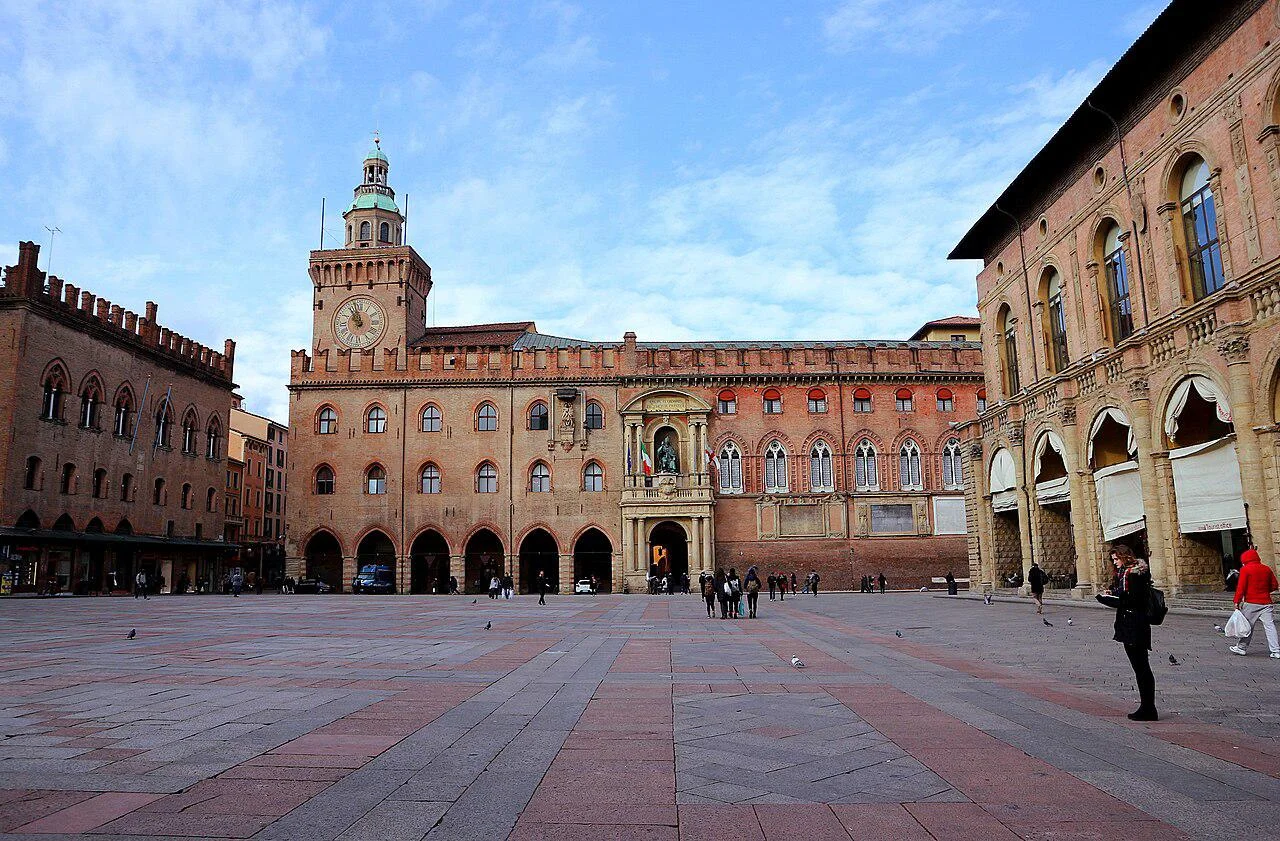
It is not only Bologna's city government that is well established. So, apparently, is its tradition of civic and municipal innovation. Bologna was a prominent member of the flotilla of city-state republics that developed across northern and central Italy between the eleventh and thirteenth centuries. Indeed, the jurists of its famous law school helped develop much of the legal and ideological framework that underpinned these radical experiments in urban self-government. Even after the slow decline of the city's republican autonomy from the early fourteenth century, and through plagues, wars and foreign domination, Bologna appears to have maintained, along with other northern Italian cities and regions, a strong civic culture. This was expressed first through craft guilds, neighbourhood associations and religious fraternities, and from the nineteenth century, through political clubs, mutual aid societies, trade unions and economic cooperatives of many kinds.
It was this culture which the American political scientist Robert Putnam famously placed at the centre of his 1993 study, Making Democracy Work: Civic Traditions in Modern Italy. In the early 1970s, the Italian state established a new and powerful level of regional government across Italy. Putnam set out to study the development and performance of these authorities over two decades. He noted that the regions in the North of Italy far outperformed the South on a wide range of measures including administrative efficiency, policy innovation and service delivery. And he traced this to long-established traditions of civic association and cooperation in the North – traditions that could, indeed, be traced all the way back to the era of the city-state republics. And while all the new Northern regional government performed well, Bologna's home region, Emilia-Romagna, was consistently at the top of the charts.
Of course, a region is not the same as a city. It is possible that Emilia-Romagna was well governed while Bologna itself was not. But we also have another classic study, from roughly the same period, which focused directly on the city. In 1976, three Swiss German journalists, Max Jäggi, Roger Müller and Sil Schmid, published Das rote Bologna, translated into English the following year as Red Bologna. The book offered a detailed account of the policies and practices of Bologna’s communist-led municipal government, presenting the city as a model of democratic, participatory and effective local administration.
Red Bologna was especially influential in left-wing circles, but the policies it described were not always easy to place on a crude left-right axis. The city government was strongly supportive of small local businesses, including women-led enterprises, and worked closely with the organisations representing them. At a time when many European and North American cities were demolishing older neighbourhoods to make way for towers, roads and cars, Bologna took a more conservative approach: preserving its historic urban fabric, restricting traffic, investing in public transport, and protecting the social life of the old city. And when many governments were using new technologies and administrative systems to centralise control, Bologna experimented with neighbourhood councils and forms of decentralised participation.
Today the city of 400,000 residents – the 7th largest in Italy - faces new challenges, including ever hotter summers, a huge influx of tourists which threatens to overwhelm the city centre and severe housing shortages. But while the main body of the city government has moved to a shiny new glass and steel office building on the edge of the city, all the signs are that Bologna has remained a high performing and innovative municipality. The 2023 series of The Municipal Administration Quality Index ranks Bologna 8th out of 107 Italian cities for the quality of its system of urban governance. The city is an active member of European and global city networks and capacity building programmes. It is one of the nine Italian cities to have received funding as part of the EU's 100 Smart and Climate Neutral Cities Mission, and its City Councillor for International Relations and European funds, Anna Lisa Boni, was formerly Secretary General of Eurocities, one of Europe's largest and most influential city networks, with close ties to the EU.
One feature of Bologna's recent municipal history, very much in keeping with it long history of civic innovation, is the way it has embraced the idea of the urban commons. In 2014, the city adopted a Regulation on public collaboration between citizens and the administration 'for the care and regeneration of urban commons'. This created a formal mechanism through which citizens, associations, informal groups, schools, businesses and other organisations could enter into "collaboration pacts" with the municipality to care for, manage or regenerate public spaces, buildings, green areas and other shared assets. The city has also established a series of independent foundations, like the Fondazione Innovazione Urbana (Foundation for Urban Innovation) to facilitate public engagement in city government. These models have since been widely studied and adapted by other Italian municipalities.
As part of the Bloomberg LSE European City Leadership Initiative, we at LSE Cities are currently working with peer researchers from the Comune and a local ethnographer, Sara Chinaglia, to better understand what drives or holds back innovation in municipal government. Why is it that some cities, like Bologna, seem to find innovation easier than others? What role does committed leadership play versus skilled officers, or dedicated innovation teams or budgets? How important is the broader culture of a city hall or a city? What role for civil society, universities, innovation businesses or city networks?
Bologna is a fascinating case study. It might be tempting to think that its apparent capacity for innovation can now be taken for granted - that creativity is hard-wired into its constitution or imprinted on its municipal DNA. That it is as enduring as Bologna's Palazzo Comunale. But that is not much of an explanation - especially for cities that are looking to develop their innovation capacity and might want to learn from cities like Bologna. Describing innovation in terms of 'inherent innovation capacity' is close to vacuous.
We are still in the data collection stage of our work, but here are a few high-level insights. First, Bologna’s strengths cannot be explained by any favoured status, when it comes to laws or funding. The city suffers from the same externally imposed limitation as most European city governments. Most taxes raised in the city go to regional, national and EU levels of government, and the municipality's capacity for innovation is limited by the same regulations as everyone else. One reason the city has supported or worked through external foundations and arm’s-length bodies is precisely that these can sometimes operate with greater flexibility, especially in areas such as recruitment and procurement. The city seems good at working round regulations and restrictions.
Second, Bologna seems to have been fortunate in its leadership: many of its mayors have had distinguished careers beyond their period in office. After a successful tenure as mayor from 1966-1970, Guido Fanti became the first President of the Emilia-Romagna region and then served as a Member of the European Parliament. Renato Zangheri (mayor 1970-1983), who over saw many of the reforms described in Red Bologna, was also a respected academic historian and went on to serve as a member of the Italian Parliament. The current Mayor, Matteo Lepore is a Member of the European Committee of the Regions, the EU's official advisory body of local and regional representatives, was a co-founder of the cross-European Mayors4Housing Alliance and is a leading voice on European urban affairs.
Third, Bologna's government both benefits from but is also open to ideas, technologies and practices emerging from it exceptionally active and engaged civil society. To take just two examples, the move to give legal backing to the co-governance of the urban commons described earlier was a response to neighbourhood groups wanting to be able to own and manage shared spaces, while the Fondazione Innovazione Urbana was co-developed with Bologna University among others. As Putnam argued 30 years ago, effective government depends in large part, on an active civic culture.
Of course the Comune di Bologna has its weaknesses as well as its strengths. All large organisations do. And it's natural for leaders, officers and the public to focus on these weaknesses. But there is also value in understanding what makes a consistently high functioning and innovative municipality tick – and what other cities can learn from this.
This blog post was prepared under the umbrella of the City Government Innovation (CGI) Deep Dives hosted by LSE Cities at the London School of Economics and Political Science. It is part of the Bloomberg LSE European City Leadership Initiative funded by Bloomberg Philanthropies.