

Can a metro station, on its own, create a vibrant, walkable neighbourhood?
One of our Executive MSc in Cities participants, Sultan Alkhuraissi, Class of 2024-26, explores how Riyadh Metro can go beyond mobility to shape active, climate-responsive urban districts in a city historically shaped by automobile-oriented growth.
The Challenge
My consultancy started from a simple premise: a metro station is not automatically a transit-oriented place. Around Riyadh Metro, the opportunity is to translate a major mobility investment into walkable, active, climate-responsive districts within a city historically shaped by automobile-oriented growth.
I explored three contrasting station contexts: KAFD as a CBD, STC/Olaya as a mixed-use corridor, and Qasr AlHokm as a heritage district, combining TOD literature, spatial analysis, expert interviews, policy review, and a practitioner workshop. Riyadh-based practitioners helped move the framework beyond textbook principles toward implementation: clearer roles across institutions, service patterns aligned with urban activity, and climate-responsive pedestrian access.
The Findings
The most important lesson was that Riyadh’s TOD opportunity is not a single template. KAFD highlighted activation around high-capacity infrastructure; STC/Olaya showed the relationship between transit service and daily/evening activity; and Qasr AlHokm demonstrated how historic fabric can support walkability.
The EMC in Practice
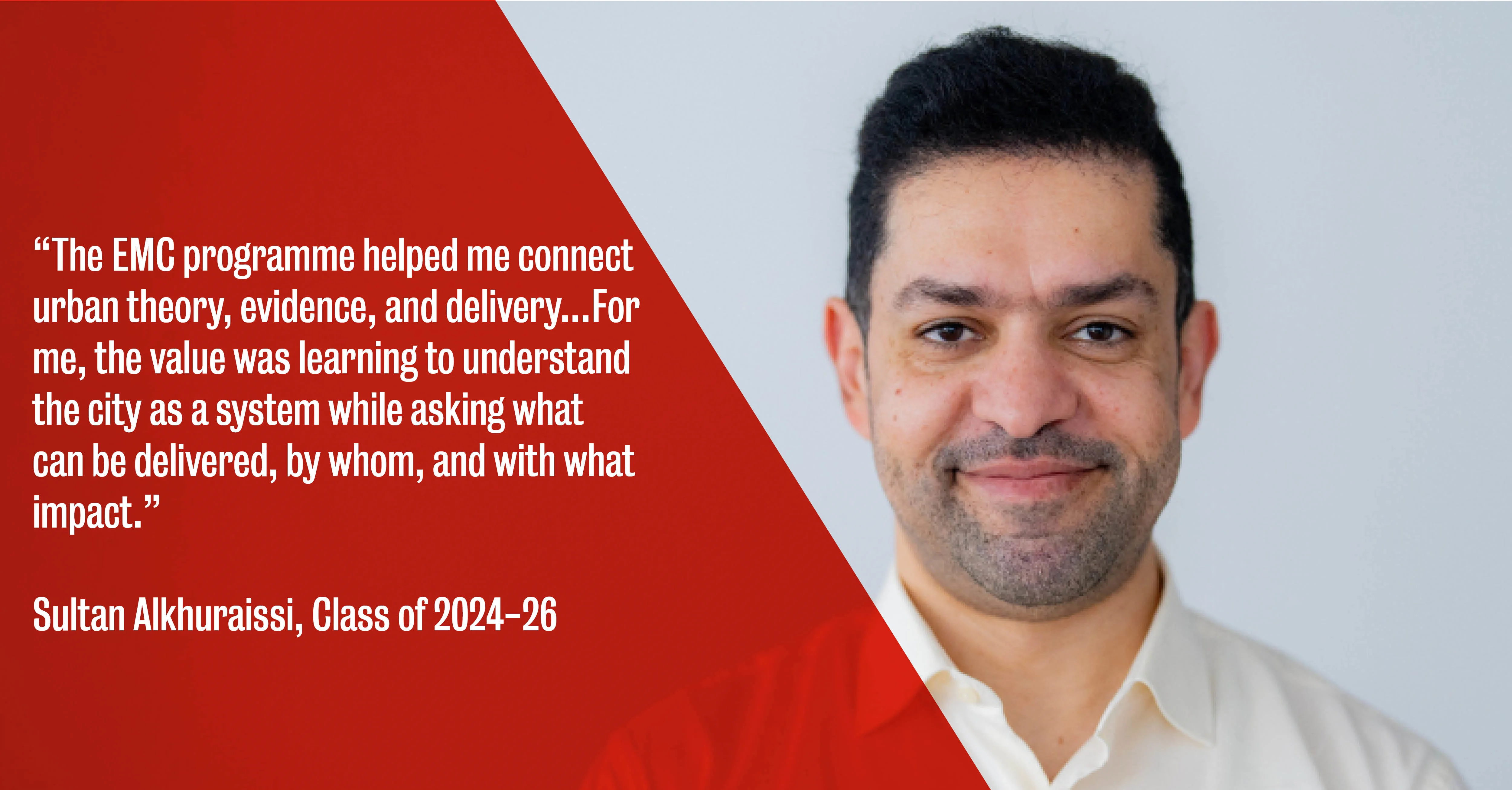
The EMC programme helped me connect urban theory, evidence, and delivery. It strengthened my ability to diagnose urban challenges systematically, test assumptions through data and practitioner insight, and translate analysis into practical interventions. For me, the value was learning to understand the city as a system while asking what can be delivered, by whom, and with what impact.
Sultan Alkhuraissi is the Chief Operations Officer, Royal Commission for AlUla. As part of the Executive MSc in Cities at LSE Cities, his consultancy research examined how aligning institutions, regulations, and design can strengthen transit-oriented development around Riyadh Metro stations.