

Reimagining Schools in Post-War Kyiv
What should a country do with its school buildings after war —demolish and rebuild, or adapt and transform?
One of our Executive MSc in Cities Participants, Erlan Zhakin, Class of 2024-26, asks this pivotal question.
The Challenge
My consultancy project asks a deceptively simple question: when a country rebuilds its schools after war, should it demolish the old ones or transform them? The project explores how Kyiv’s Soviet-era school buildings can be adapted for resilient, inclusive and child-centred education in the context of Ukraine’s post-war reconstruction. The instinctive answer is to build anew. But the numbers told a different story: replacing the existing stock would cost up to €2.1 billion and require 200–250 new schools, against €360–636 million for adaptation. The real obstacle isn't the architecture; it's the rigid corridor-classroom logic that no longer fits how children learn or how schools must now also shelter them.
The Findings
What surprised me most was discovering that adaptation is not a compromise but the more ambitious path. Drawing on Estonia's gradual transformation and Kazakhstan's BINOM schools, I learned that post-Soviet infrastructure could evolve without losing its identity.
The EMC in Practice
The most valuable learning from the MSc has been to connect spatial analysis with governance, finance, and social justice. A technically elegant solution is not enough if it cannot be scaled, funded or owned by the community.
Future Impact
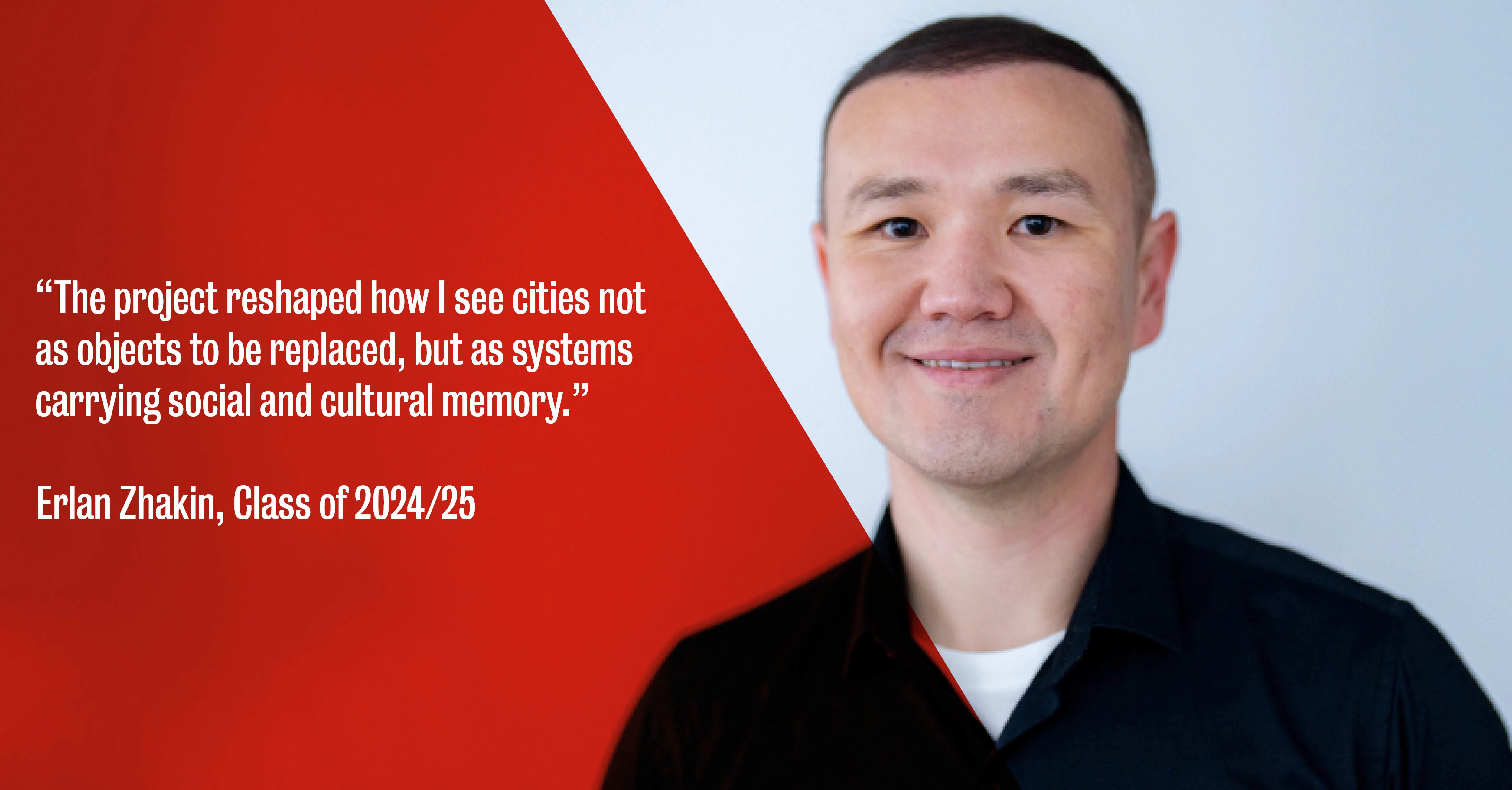
Beyond the programme, this experience will influence how I approach urban infrastructure: not only as construction, but as institution-building and long-term civic and social resilience. The project reshaped how I see cities not as objects to be replaced, but as systems carrying social and cultural memory. The LSE framework on urban inequality taught me that a school building is never just a building; it either reproduces or reduces social divides.
Erlan Zhakin is an international business development executive at construction & development firm BI Group, focused on urban infrastructure, resilience construction projects, and company's market expansion across Ukraine and Central and Eastern Europe.