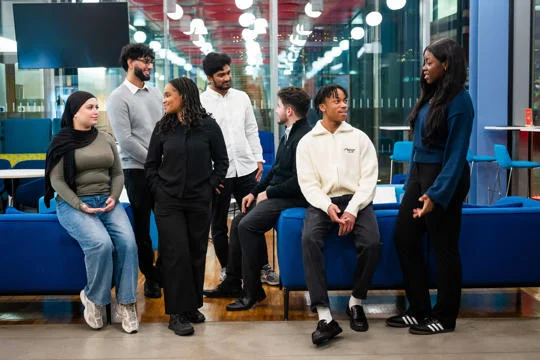

LSE alumni driving change on educational inequity
For three LSE alumni working with the Fair Education Alliance (FEA), tackling educational inequity in the UK could not be more personal. Gina Cicerone, Liz Robinson and Zulum Elumogo have each arrived at the FEA by a different route, and at a different moment in their own careers, but with a shared belief that educational inequity in England can, and must, be fixed at the root.
The FEA is a coalition of 300 member organisations from business, education, and civil society, working to tackle the root causes of educational inequity through cross-sector collaboration and systems change. Gina Cicerone, Liz Robinson and Zulum Elumogo each bring different perspectives to their roles at the FEA, united by their shared commitment to fix the root cause of the issue.
A failure of imagination
"It's a failure of imagination as to how we can do this better in the UK", says Zulum Elumogo (BSc Social Policy and Government 2018), who was the first Black male General Secretary of LSE’s Students’ Union, later going on to become trustee at the FEA from September 2020, then Vice Chair from 2024.
He points to a country where seven per cent of children are privately educated yet go on to dominate its most influential roles, and argues that most proposed solutions "make an unequal system slightly less unequal, rather than making a more equitable system." He invokes LSE's founders and the creation of the NHS in 1948 as the level of ambition and radical thinking he wants applied to education now, “I want to bring up LSE's motto here, to know the causes of things for the betterment of society, which has always been so inspirational.”
For Zulum, that means understanding not just the outcomes we see today, but the causes behind them:
We are the inheritors of yesterday. We are building the foundation for tomorrow. And what we're trying to do is improve the foundation for tomorrow. It's as simple as that.
His route into the FEA started with another LSE alumnus: an enrichment coordinator who'd studied social policy alongside Zulum invited him to speak at the Mulberry Youth Conference in 2020, where FEA's then-chair and CEO of Mulberry Schools Trust, Dr Vanessa Ogden CBE, was moderating and later invited him onto the board. His own motivation for the work traces back further, to his mother's arrival in the UK from Nigeria on a British Council scholarship in the 1990s, " So, it's sort of who I am and what I believe in. If we can get this right when it comes to education and training and provide everyone the investment that they truly need, we're going to be much, much better off", he says.

On what LSE gave him: "It's the single most ambitious place I've ever known." His message to fellow alumni: "Fund us" and think long-term. The FEA has spent a decade improving outcomes, from cradle to career. The work is uniquely placed at local, regional and national levels. "There's a role for everyone," he says, "whether it be funding at that major level, or just collaboration and partnership."
I turned right, not left
"Most people turn left out of LSE and go into the City. I turned right," says Liz Robinson (BSc Philosophy 1999), the FEA's incoming Chair of Trustees, referencing the career that followed her time studying at LSE.
She went straight from her degree into teacher training, and into some of London's most socially complex school communities, becoming a head teacher by her late twenties. Her route to the FEA came from wanting to work further upstream than any single school allows:
You can run 10 schools, you can run 20 schools, you can run 50 schools – which sounds like a lot, but there are 26,000 schools in England. It's about a systems-thinking mindset, and about many different people working together in this complex environment. The FEA is an expression of how I already think about the world.
Liz traces the roots of that thinking to LSE – though, taught partly at King's under the intercollegiate arrangement, she studied twentieth-century continental philosophy, providing a grounding that underpins Big Education's approach to developing young people as academically successful, confident and engaged members of their communities. She led the academy trust until it merged with Oasis Community Learning, bringing together two organisations with a shared commitment to inclusive, holistic education. She now serves as National Director for Education Transformation at Oasis.
She's direct about what makes the FEA different: “plenty of organisations talk about collaboration”, Liz says, but few actually build "a really tangible example of collective action," with a genuine theory of systems change behind it, which is what makes her so proud to be involved.

On what she'd say to fellow alumni who want to get involved, her answer comes down to collaboration:
“Collaboration is the only way we are going to make real progress on some of society's wicked problems. Finding others who share your values and mission is key; it’s what enables us to leave our siloes and our egos at the door and get on with the job at hand. It’s much more effective, it’s much more impactful and it makes the work much more fun!”
We are the traffic
Gina Cicerone (MSc Development Management 2013) arrived at LSE at 27, having already run a nonprofit in Ecuador. "I'm walking down the street in Brixton, and going – wait, why are we talking about another country? Look at the vendors in the market" she recalls, of realising how directly her development studies applied to the inequality she saw in London.
She's spent six years as the FEA's co-CEO and, since May, as sole CEO, leading a secretariat of around 20 people supporting the 300 members across three strands:
- Collective voice: influencing policy and public narratives to improve outcomes for children and young people from low-income backgrounds.
- Collective action: bringing organisations together to tackle the root causes of educational inequity, aligning their efforts and taking coordinated action nationally and in places through Mayoral Strategic Authorities.
- Collective strength: building members’ capacity and systems leadership skills so they can create greater change individually and collectively.
Two golden threads run throughout all of their work – youth leadership and AI and technology.
The scale of the problem, in her words: 4.5 million children and young people now living in poverty, more than 30 per cent of five-year-olds not meeting good levels of development; a 19-month GCSE attainment gap between poorer pupils and their wealthier peers – gaps that, even against the government's own targets, would still leave children from low-income backgrounds significantly behind. "This needs to be systemic," she says. "This is long-term. We need to go into this with eyes wide open."

Her call to fellow alumni is to join the FEA. Membership is free for civil society organisations, and offers businesses the chance to "walk the walk" on educational equity while supporting their own future workforce. But she also asks them to consider something else:
We often complain about being stuck in traffic. And then there’s the realisation: wait, hold on, I am the traffic. Understanding our role in the system, and how we might inadvertently be upholding educational inequity is key. Is it our recruitment practices? Is it our involvement in our community? The FEA gives organisations a way to be part of changing that system. That's the number one thing I hope comes from this.
She credits LSE’s Careers service with playing an important role in helping her secure her first UK role. At 28, with limited local professional network to lean on, she worked with the careers team to structure her CV and prepare for the interview process. That support helped her successfully secure the role, and the visa sponsorship that came with it.
The mission continues
Three different routes in, and three different points in the FEA's story right now. What connects them, as Zulum put it, closing out the conversation: "A better tomorrow really is possible if we work towards it."
Sam Bailey, Head of Widening Participation at LSE, sees the alumni's work as part of a wider institutional thread:
"Gina, Liz and Zulum are powerful examples of LSE alumni taking the lead in addressing one of the most pressing social challenges we face today. Their work with the Fair Education Alliance shows the impact our alumni can have beyond LSE; building partnerships, shaping systems and creating lasting change for young people across the country.
LSE's Widening Participation work builds on a legacy created by alumni who have used their education to challenge inequality and expand opportunity. Their impact reflects the values that guide us – to ensure that young people from every background can see a place for themselves at LSE and in Higher Education."
Read more about the work of the Fair Education Alliance and explore opportunities to support their mission.
August 2026
Donate to our Scholarship Fund