

A flare for business: Delivering entrepreneurial solutions

From a student entrepreneur to a founder building his delivery solution business from the heart of campus, Daniel Parekh-Hill’s LSE journey has come full circle. Here, he looks back on his entrepreneurial evolution, how he got the idea for his business and why he signed LSE’s Entrepreneurs’ Pledge.
From LSE to entrepreneurship: Where it all began
I got involved with entrepreneurship straight away at LSE, joining the cross-university incubator, KickStart Global Team, in my first year. I wanted to work on problems that genuinely mattered to people, and I was able to do that at KickStart Global, making it easier for students to start businesses that solved important problems.
Then, in my third year, I travelled to Shanghai with a team of LSE students to pitch a blockchain-based business idea. This was a new area for me, but it taught me how to find problems and craft solutions. Looking back, LSE offered more entrepreneurial opportunities than I expected - and those experiences planted the seeds for what came later.
These types of projects showed me what it meant to create something from nothing and put them into the hands of users. Entrepreneurship became a way to combine problem-solving, creativity and meaningful work to have a positive impact on people and our environment.
After LSE
After graduating, I started my career in investment banking. I was drawn to working on large strategic decisions with impact, including projects like transitioning Daimler (Mercedes) towards electric vehicles. However, over time, I came to realise I was a small part of a very large machine, with only limited room for creativity or innovation. I moved into high-growth companies such as GoHenry and Labster, where I worked on strategy and helped build products and processes from the ground up. These experiences gave me the confidence and skills to build something myself.
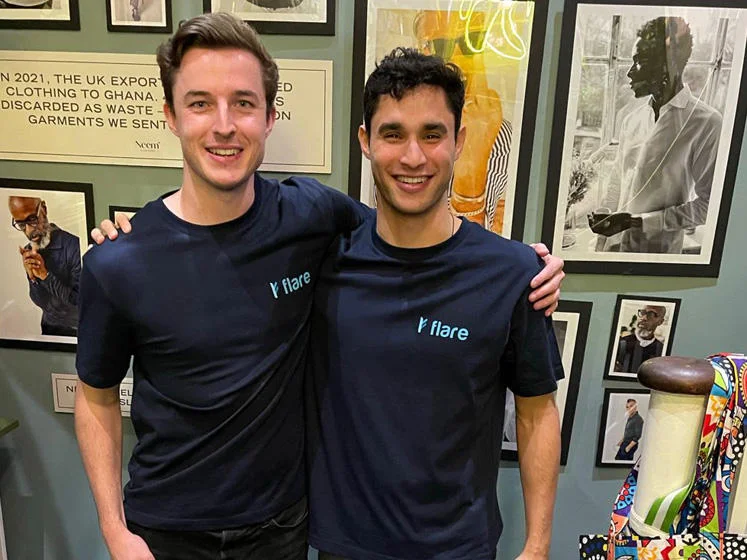
I decided to join Entrepreneurs First, an international talent investor, and it was there that I met my Flare co-founder, Alex. I had seen how delivery uncertainty creates friction in online shopping and operations. Big retailers invest millions in custom delivery systems, but smaller brands are stuck with clunky workarounds or no solution at all. We saw an opportunity to level the playing field by making enterprise-grade delivery software accessible to thousands of Shopify brands. Together, we developed Flare to help e-commerce brands offer delivery date selection at checkout - similar to what Amazon, Tesco, and Sainsbury's have built in-house, but at a fraction of the cost. Ultimately, our goal was to give customers clarity and control over delivery dates while helping hundreds of e-commerce teams save time across their customer experience and operations.
Skills, networks and ideas built at LSE
To build Flare, I returned to campus to use LSE Generate’s co-working space. In those days, shared resources and free support were invaluable to us, as keeping costs down meant survival. However, beyond this practical support, LSE's network of ambitious students, entrepreneurs and mentors also gave me confidence that unconventional career paths were not just possible but encouraged.
LSE Generate ultimately gave us the foundation to build Flare - space, resources, and belief when all we had was an idea. I decided to sign the LSE Entrepreneurs’ Pledge as I would like to give back and create opportunities for the next generation of LSE entrepreneurs. Entrepreneurship is about finding problems that matter and solving them. Supporting LSE's entrepreneurial ecosystem means more students get the chance to build solutions to real-world challenges, rather than just studying them.
Advice for future LSE entrepreneurs
Over the next two years, we aim to expand Flare’s core delivery and shipping capabilities and serve over 1,000 customers globally. Our ambition is to build Flare into a delivery intelligence platform that connects customers, businesses, and logistics, helping online commerce become more reliable and efficient. As we grow over the next 5-10 years, I want to continue supporting and mentoring founders who are focused on solving important problems with a positive impact on people and society.
For those interested in starting your own business, I advise you look for a market where people are already spending money - it's much easier than creating demand from scratch. Then search for a specific problem and research it thoroughly. Talk to potential customers and understand not just what frustrates them, but what they will actually pay to fix it. The gap between “this is annoying” and “I'll pay to solve this” is enormous. Sign your first customers before you've built everything. Their feedback will save you from building the wrong thing. Then use those early customers to sign more - social proof matters more than perfect software. Most importantly: start before you feel ready. You'll learn more in one month with a half-ready product than in a year of planning!
Daniel Parekh-Hill
BSc Economics 2018