
Creatives in Residence

The Firoz Lalji Institute for Africa Creative in Residence Programme
The Creative in Residence Programme fosters innovation and collaboration between Africa's booming creative economy and LSE's excellence in academia.
The programme brings creatives with a track record of creativity and leadership to LSE to connect with the latest academic research to help drive change through their creative outputs. FLIA's academic researchers collaborate with FLIA's Creatives in Residence to expand the reach of our research to new audiences and support science communications.
Our current Creative in Residence Fellows are: Chude Jideonwo, Dr Tunde Alabi-Hundeyin II, Ama Ofeibea Tetteh, and Ian Mangenga.
It’s obviously an incredible honour to get this appointment and to be part of the LSE community. There is no better time to be co-creating with the faculty and community across the schools to enrich and enable Africa’s creatives and Africa’s sparkling creative economy that is set to take over the world.
Each Fellow is invited to affiliate with the Institute for a one-year renewable term. The Institute holds an open call for applications once a year. For more information about the process, please contact Mark Briggs on m.a.briggs@lse.ac.uk.
The primary responsibilities of CiRs will be as follows:
- Inspire, engage, and facilitate access to development opportunities in creative industries for the students in the Programme for African Leadership and alumni network.
- Support and advance the work of the Institute in Africa's creative economy.
Chude Jideonwo | FLIA's first Creative in Residence

Chude Jideonwo is a renowned media entrepreneur and co-founder of RED For Africa. As Creative in Residence, Chude will leverage his extensive expertise and creativity to inspire and engage with PfAL and support the Ubuntu Café events series.
By engaging with PfAL, Chude will help support the development of future African creative leaders. His vast experience in film and media will be instrumental in enhancing creative opportunities for LSE students.
Chude has been instrumental in helping to establish the Creatives in Residence Programme. As part of his inaugural fellowship, he hosted several events at the Institute to showcase his work and engage with students about how to pursue creative work.
The Institute launched the Chude Jideonwo Prize for Creativity 2025 for Master’s students in his honour. The prize is about amplifying the quiet voices that often go unheard and recognising the visions that shape how we live, dream, and imagine.
Dr Tunde Alabi-Hundeyin II | Creative in Residence

Dr Tunde Alabi-Hundeyin II is a documentary filmmaker and media creative whose work interrogates culture, identity, power, and social justice. He holds a PhD in Creative and Critical Practice from the University of Sussex. His acclaimed films and photo exhibitions have been showcased globally, inspiring new conversations about African agency, ethical storytelling, and the power of photography and film as tools for advocacy.
Project: Visual storytelling
As a Creative in Residence at LSE, Tunde brings his creative lens to academic inquiry, supporting students and researchers to integrate visual methods and creative practice into their work. He works closely with the Programme for African Leadership (PfAL) to mentor students and alumni exploring careers in media and the creative industries. His CiR activities include developing public-facing outputs, supporting research grant applications involving creative methodologies and contributing to FLIA events.
Through this fellowship, Tunde continues to blur the boundaries between art and research by amplifying marginalised voices, shaping new forms of public engagement, and deepening the impact of storytelling across disciplines.
Ama Ofeibea Tetteh | Creative in Residence
Ama Ofeibea Tetteh is the founder and lead consultant at Chapter54. With a background in Graphics & Communications, Research and Programme Management and academic qualifications from Central St. Martins, Goldsmiths College and SOAS, her career portfolio is driven by a passion to harness the Arts and Creative sector to create opportunities and contribute to new narratives about the Continent.
Having worked within the Creative and Cultural Industries for over two decades, her professional offering centres on a deep understanding of cultural nuance and appreciation for the artistic as well as the operational.
Project: Diasporic Currents & Cultural Flows – Exploring Creative Ties Between West Africa and the Caribbean (2022–Ongoing)
"This project, developed through my consultancy Chapter54, will explore the potential of the creative sector as a tool for deepening collaboration between West Africa and the Caribbean, two regions historically linked yet often treated in siloed cultural and policy spaces. By activating transnational creative relationships, the project aims to uncover how shared histories, aesthetic languages, and current socio-political realities can be harnessed through contemporary creative practice to build new bridges of understanding and co-creation."
Ian Mangenga | Creative in Residence

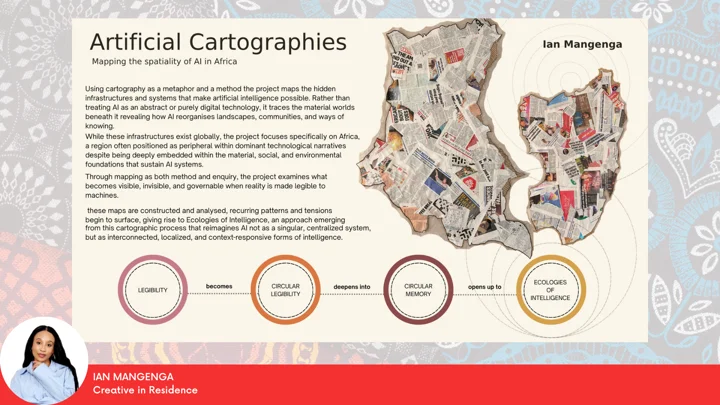
Ian Mangenga is a social designer and AI ethics & governance researcher whose work explores how algorithmic systems quietly shape identity, access, and power, with a particular focus on the experiences of African women. She is the founder of Digital Girl Africa, a community incubator advancing AI literacy and digital confidence for women across the continent.
She is currently completing an MA in AI, Ethics & Society at Birkbeck, University of London.
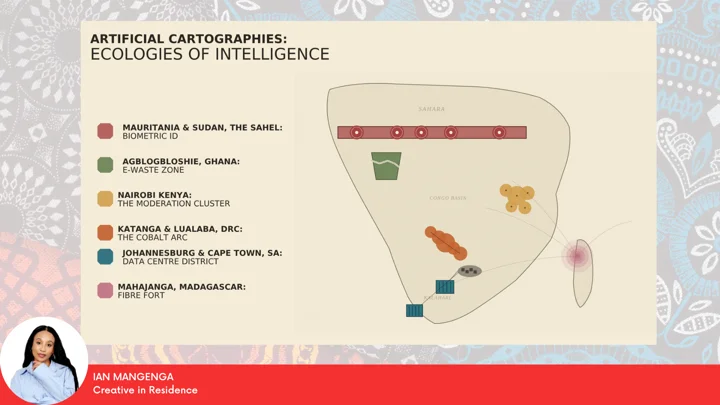
Project: Artificial Cartographies – Mapping the Spatial Contours of AI in Africa
"This is a story about where AI touches down and what happens when it does: the frictions it creates, the worlds it reorganises, and the quiet, often overlooked terrains that hold up the global imagination of “the cloud", while reframing Africa as central, not peripheral, to the world's algorithmic future.
Through multimedia storytelling, visual research, and creative inquiry, the project traces these spatial entanglements across Africa, assembling a narrative that is as much about technology as it is about land, power, and the futures being built beneath our feet."