


Tell, don’t ask: how to mobilise climate action on social media
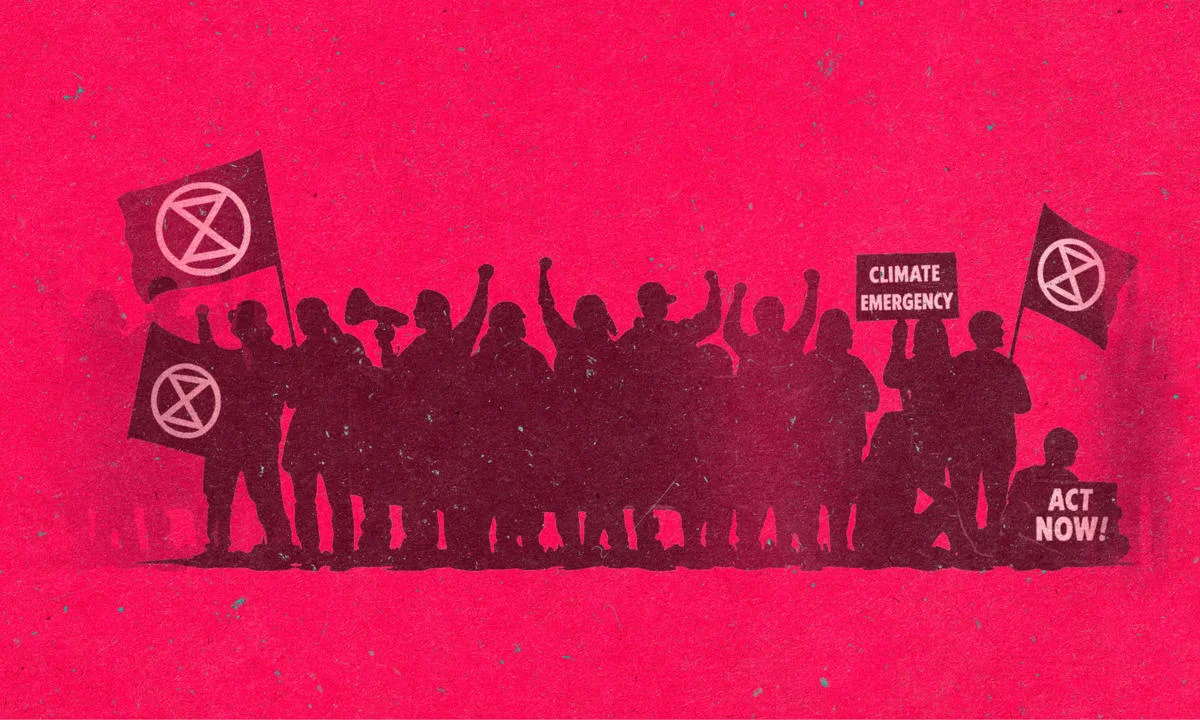
Social media can act as a powerful tool for climate movements seeking to engage supporters and organise collective action. But with multiple options available for messaging and imagery, what stands out amidst the online noise to attract new supporters?
Dr Ganga Shreedhar, Assistant Professor of Behavioural Science in the Department of Psychological and Behavioural Science at LSE, led a study to examine how climate movements can use social media to promote local public engagement, and the types of language and social imagery that could affect willingness to engage. The resulting paper, Tell don’t ask: how to use social media to mobilise local collective climate action, analysed the results of a randomised controlled field trial conducted in collaboration with the global environment movement Extinction Rebellion (XR), reaching over 350,000 Facebook users across Birmingham, Cardiff and Oxford.
The trial served a random selection of adverts to Facebook users within 30 kilometres of each city, inviting them to register interest in attending a local Extinction Rebellion talk. These adverts varied in imagery – from climate impacts to protest scenes and diverse participants – and also in tone, contrasting direct exhortations with softer requests.
At the forefront of the study was a broader question: how do you move people from passive concern to collective action?
From individual action to collective momentum
The study forms part of a wider debate about the limits of individual responses to climate change and the need for collective mobilisation. Dr Shreedhar explains: “We wanted to understand how to encourage people to take more collective climate action. Wherein they can work with others, ideally in the community, to build both a sense of momentum and a sense of collective efficacy.
“There’s an increasing debate about what we can do as individuals to address climate change, and there’s a real anxiety that individual action, for example changing to energy-saving lightbulbs, is futile. The question is also not just about the impact you can have, but whether we’re having impacts at a scale fast enough to motivate structural change, to get the government to listen and do things, which is the real way to create change.”
This emphasis on collective action reflects the notion that acting together, rather than alone, can reshape how people experience the climate crisis itself.
“Local collective action can create strong communities,” she says. “Coming together to work out how we can change the system is really important, because we know that acting with others reduces climate anxiety. There’s a lot of literature that covers the anxiety felt by both younger and older people around climate change, and I think this is reflected in the ages of the people you see who are out protesting – the ages range across the board.”
The challenge for those involved in climate action lies in reaching those not already engaged. This is where social media can offer reach but isn’t always effective.
Testing the climate message
Working with Extinction Rebellion – the UK’s largest collective climate action movement – the research team designed a field experiment that would work alongside the organisation’s existing outreach.
“We were working with Extinction Rebellion in relation to a schedule of local talks they had arranged, and we carved out the project in two phases. A co-author carried out the qualitative research with them to explore the perceptions of how Extinction Rebellion is reaching out to people and how should they experiment with different strategies. That was the qualitative section of the project, which informed the quantitative section, which was the Facebook trial,” explains Dr Shreedhar.
The choice of Birmingham, Cardiff and Oxford reflected practical constraints and a varied audience.
“We chose those cities partly because that's where Extinction Rebellion had scheduled the talks. Secondly, because they also reflected different areas of the UK. Cardiff was in Wales, Birmingham is the Midlands, and Oxford is towards the South where you could say that there's a traditional climate outreach. Although they are all urban spaces, they have quite different profiles.”
Across these cities, users were randomly shown one of several advertisement combinations, pairing different tones of voice with different types of imagery.
“Each individual would have seen on their Facebook feed one particular way of inviting them to register interest in coming to a talk – either an exhortation or a request, with one of the images – and we had three categories of images,” sets out Dr Shreedhar.
“The impact imagery – which was flooding – was to convey the urgency and the stakes involved in terms of the climate imagery. The default image was what Extinction Rebellion typically uses, which is protest imagery signalling a social norm. The third image was diversity-focused imagery, which was trying to reach out to people who might not look like the stereotypical XR activist.”
So, what actually motivated people to act?
The power of telling
“We found you really have to tell people and not ask them, which is why it's in the title of the paper. Prior to our expectations and what we found in the qualitative data, people didn't respond to being asked nicely. They responded to messaging that told people to act.”
For Dr Shreedhar, one phrase in particular stood out: “The phrase we used was ‘don't stand by idly’, which is very much the default Extinction Rebellion messaging. This phrase was actually the most impactful, especially when it was paired with the flood imagery.”
This combination of direct instruction and depictions of climate impact outperformed all alternatives.
“We also found that exhortation works better than requesting in this context. And across the board, requests to act, as opposed to telling people, underperformed across all cities and image types. I think the headline finding of the study is you have to tell people and not ask, and really communicate the urgency.”
The result challenges a common assumption in campaigning, which often uses softer, more inviting language. Instead, the evidence suggests that where the issue is deemed to be urgent, a polite tone can reduce the credibility of the message.
![Asking nicely...when it's an urgent crisis...[can induce] people to discredit the message entirely.](/all-images/mobilise-climate-action-social-media-1200x628-quote3.xa64879f2.jpg?w=2500&h=1308&q=85&f=webp)
Consistent and credible climate messaging
Dr Shreedhar believes the reason that directive language works better is due to the consistency – or congruence – of message and context.
“This literature suggests that congruence is very important, so the tone and the language use have to be congruent with the situation,” she says. “I think asking nicely – for example, ‘Why don't you think about doing something when there's a flood?’ when it's an urgent crisis – means that there's some incongruence which induces people to discredit the message entirely.
“When there is congruence between the situation which you're portraying – which is, for example, climate impact or flooding combined with an urgency message – people are going to pay attention.”
Pairing urgency with less powerful imagery carries a real risk of diluting the impact of the overall message.
“I think this congruency issue is quite important and that's why I think it's tell, don't ask, when it's an emergency.”
Rethinking climate imagery
Dr Shreedhar was also struck by the performance of different image strategies. Protest imagery, for example, while central to Extinction Rebellion’s identity, proved to be less effective than the images of climate impact. Flood imagery, in particular, appeared to tap into how the general public view climate risk.
“We do know that there's a high risk of flooding in many places. We know that the UK is going to have to deal with it and climate impacts are coming and it's already being felt. So we were pleased to have it in the mix, but we didn't expect it to be so powerful with the exhortation. Seeing that interaction in action was quite stunning.”
However, the study also highlighted the limits of assuming how others understand climate change and its effects.
“Flooding and climate change are actually interlinked and people might not have the mental model to digest both those things together. I think we have to be careful when we pair these things because we have to take into account people's prior models of what the emergency is and what it would look like, otherwise your messaging might accidentally misfire.”
This means that effective communication is not just about urgency, but about aligning with how audiences already understand risk.
Place, audience and the limits of the click
The trial also revealed important differences across locations. Birmingham generated the highest levels of engagement, while Cardiff lagged behind, despite facing higher objective flood risk.
“Objective flood risk won't drive responses unless people know there's an objective flood risk and that it’s attributed to climate change. So just because there's a risk, it doesn't necessarily translate to behaviour.”
Instead, local context, which includes existing awareness and the visibility of local activist networks, may play an important role.
“It might have something to do with the existing awareness and concern in those populations as well. I think the finding here is that we have to be careful about how we focus messaging, because what works in one region might not work in the other region.
“The most defensible thing I can conclude from this is test by location, not just by social demographic group.”
Despite its scale, the study also raises questions about what digital engagement really represents. Clicking on an advert is not the same as attending a meeting or creating long-term involvement from local activists. This gap between online and offline behaviour is a challenge for both researchers and activists.
“What we can't say is that just clicking actually translates to showing up. I think there's a big gap between these two actions which is something which really needs to be unpacked, because we can't really measure real-world attendance.
“You can click, but that's different to showing up to the talk, because you could just be clicking while online. That means you might not do actual things in person.”
Beyond Extinction Rebellion
Although the study was created in collaboration with Extinction Rebellion, its implications have the potential to extend beyond the climate emergency movement. It also highlights the delicate balance between tailoring effective messaging, reaching engaged audiences and ensuring online activity extends into the offline world.
“I think this is definitely applicable to movements beyond Extinction Rebellion,” says Dr Shreedhar. “The fact that the congruence between the ask and the situation has to be intact is, I think, a really good generalisable takeaway.
“The mobilisers' dilemma is also real. You need to convey urgency without putting off people.”
The difficulty lies not only in persuading people that climate change matters, but in persuading them that action that is collective, immediate and meaningful is both necessary and possible.
Dr Ganga Shreedhar was speaking to Helen Flood, Media Relations Officer at LSE.
Subscribe to LSE Research for the World

LSE Festival 2026: How to save the planet

Research for the World is the online magazine by LSE - the London School of Economics and Political Science. LSE is a world-leading university, specialising in social sciences and ranked top in the UK by The Times and Sunday Times Good University Guide 2026.
Ganga Shreedhar

Related content
The changing relationship between governments and NGOs: from activists to service providers?

The X factor: four ways one social media platform undermined democracy during the 2024 summer riots
The fourth estate: can the media change our feelings about democracy?