

Looping effects in psychology: turning anomalies into opportunities
In a transformative new paper, Alex Gillespie and Brady Wagoner extend the concept of “looping effects,” originally introduced by philosopher Ian Hacking to describe the two-way relationship between scientific classifications and the people classified, to psychological theories. They show that psychological theories do not simply explain human behaviour — they can also shape it.
Looping effects have traditionally been viewed as destabilising or problematic. Gillespie and Wagoner argue instead that these effects are essential and should be integrated into psychological theorising. They introduce a two-by-two typology that distinguishes between weakening and strengthening effects, and whether those effects are intended or unintended. This is outlined in the table below.
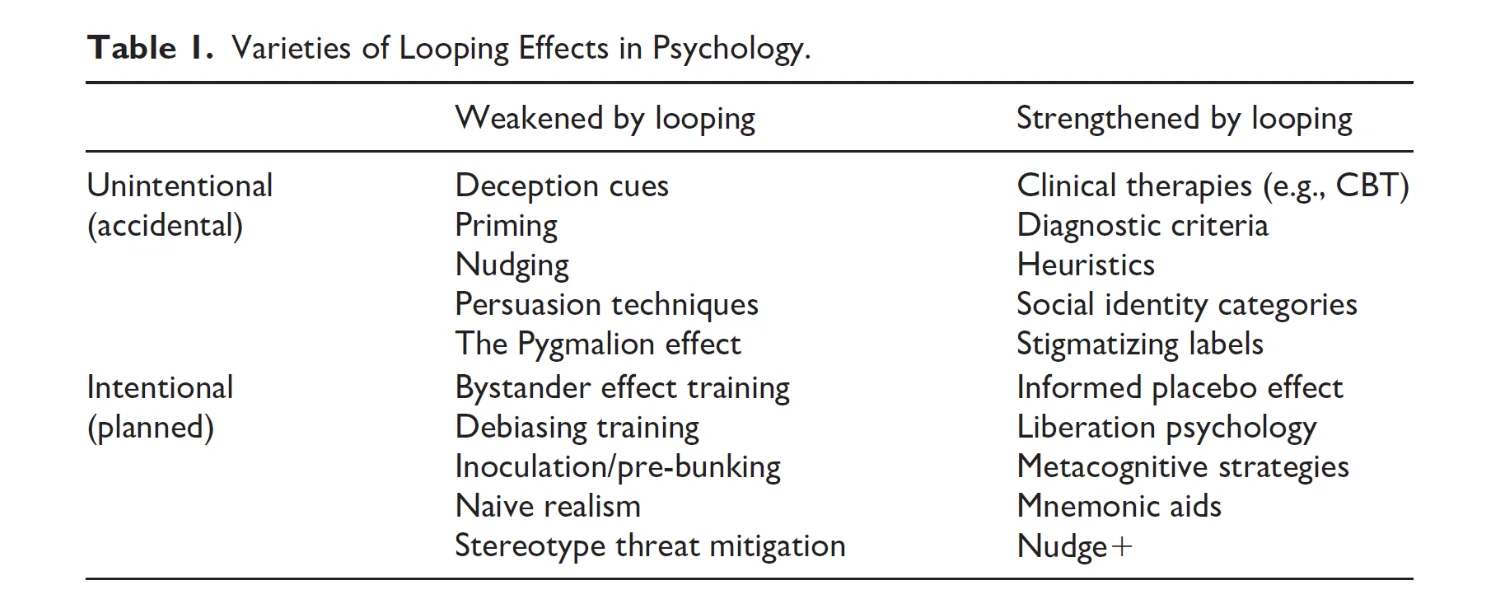
For example, theories about cognitive biases may be weakened when people learn to resist them. In contrast, metacognitive strategies and mnemonic techniques tend to be strengthened when they are taught and applied. Theories designed to predict and control behaviour often backfire once people become aware of them. Meanwhile, theories that empower individuals — for example, those used in therapy or education — are more likely to be embraced and refined over time.
The study also speaks to the replication crisis in psychology, suggesting that some failures to replicate may be linked to looping effects. Gillespie and Wagoner explain that as psychological theories become widely known, they can influence the very behaviours they were designed to measure. Rather than viewing this as a flaw, the authors encourage researchers to incorporate looping effects into their theoretical frameworks.
By bringing looping effects into mainstream theory, Gillespie and Wagoner invite a shift in how psychological science understands its relationship with society. Instead of pursuing timeless laws, psychology can focus on the evolving interplay between theory and human development — turning anomalies into opportunities for change.
This article provides a summary of research findings from the following paper:
Gillespie, A., & Wagoner, B. (2025). The looping effects of psychological theories: From anomaly to opportunity. Theory & Psychology, 35(1), 1–22. https://doi.org/10.1177/09593543251381278