

Global migration per year has nearly tripled since 2000, new study finds
Global migration has risen sharply from approximately 13 million people per year in 2000 to around 35 million people per year in 2023. This is according to a transformative new dataset on human migration published today (10 June 2026) in leading journal Nature by researchers from the London School of Economics and Political Science (LSE) and the University of Hong Kong (HKU).
This rise in migration outpaces global population growth, showing a true per-capita increase in human mobility. The trend is contrary to previous research efforts to quantify global migration flows.
Using deep learning, the researchers have built the first dataset of migration flows between all countries for the period 1990-2023, offering a far more detailed picture of global movement than traditional data, which is highly fragmented.
Current analyses heavily depend on migrant population counts published at five-year intervals by the United Nations and ten-year intervals by the World Bank, providing counts of migrants in each country by country of birth. As these traditional datasets only offer a snapshot at a fixed point in time, big events such as wars, economic recessions, pandemics, or climate shocks - have sometimes been missed in the data capture.
More detailed migration data matters because it shows not just how many people move, but when, where, and why - helping policymakers respond to crises, plan services, and understand global trends.
Through the use of advanced machine learning (deep neural networks) to combine official statistics, census data, and other sources with geographic and economic factors, the new dataset helps fill in the missing gaps.
It shows migration has become more common overall since 2000 with dips only during the 2008–09 financial crisis and the COVID‑19 pandemic.
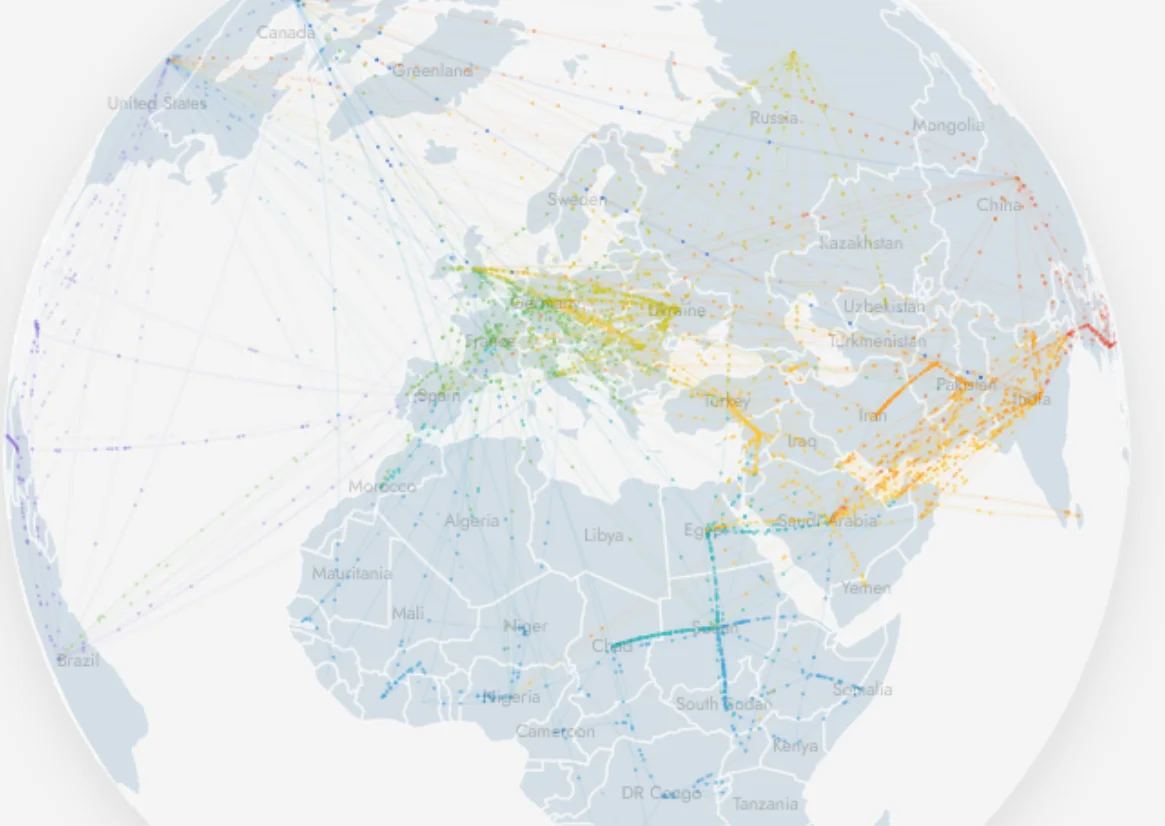
Globally, the Middle East experienced the highest total inflow of migrants, chiefly from South Asia and the Philippines, with immigration from Bangladesh to Saudi Arabia alone averaging around 300,000 people per year from 2010 onwards.
The researchers estimate that, since 2010, a total of 19m people, averaging 1.35m per year, migrated from India, Pakistan, and Bangladesh to Saudi Arabia, Qatar, Bahrain, and the UAE—this compares to 13.6m movements from Mexico to the US over the entire period since 1990.
Europe consistently ranks as the region with the highest volume of intra-regional migration, surpassed only once by Sub-Saharan Africa in the early 1990s during the Rwandan civil war.
The dataset is particularly useful in what it reveals about migration movements in the Global South, where migration data has traditionally been less plentiful and detailed than in the Global North.
In the mid-2010s, for instance, Sub-Saharan Africa saw several large-scale migration events. Civil war in South Sudan from 2013 onwards caused a large exodus into neighbouring Ethiopia.
Violence in West Africa, as Boko Haram launched an insurgency in Nigeria in 2009 and escalated attacks in 2014, including the abduction of nearly 300 schoolgirls, saw an estimated 79,000 Nigerians flee to neighbouring countries, with most (45,000) going to Niger between 2013 and 2014.
Commenting on the new dataset and its significance, lead author of the paper Dr Thomas Gaskin, a postdoctoral researcher at the Department of Methodology at LSE said: “Our estimates were obtained by combining classical flow modelling with deep learning, utilising a wide range of data for model input and training; I think the scale and breadth of this dataset really showcases the potential of this kind of hybrid modelling in the computational sciences.”
Paper co-author Professor Guy Abel from the University of Hong Kong and the International Institute for Applied Systems Analysis (IIASA) added: “Because previous estimation methods relied on coarse five-year snapshots, they yielded very few data points and created the impression that the rate of global migration flows was stable. Our annual data provides a clearer picture, revealing that this rate has actually risen since 2000. This upward trend appears to be driven by long-term demographic shifts and economic development rather than sudden, isolated crises.”
An interactive website visualising the global migration estimates can be found at https://www.socsc.hku.hk/rhps/global-migration/