

New research finds ecological factors, not social behaviour, explain brain size in cephalopods
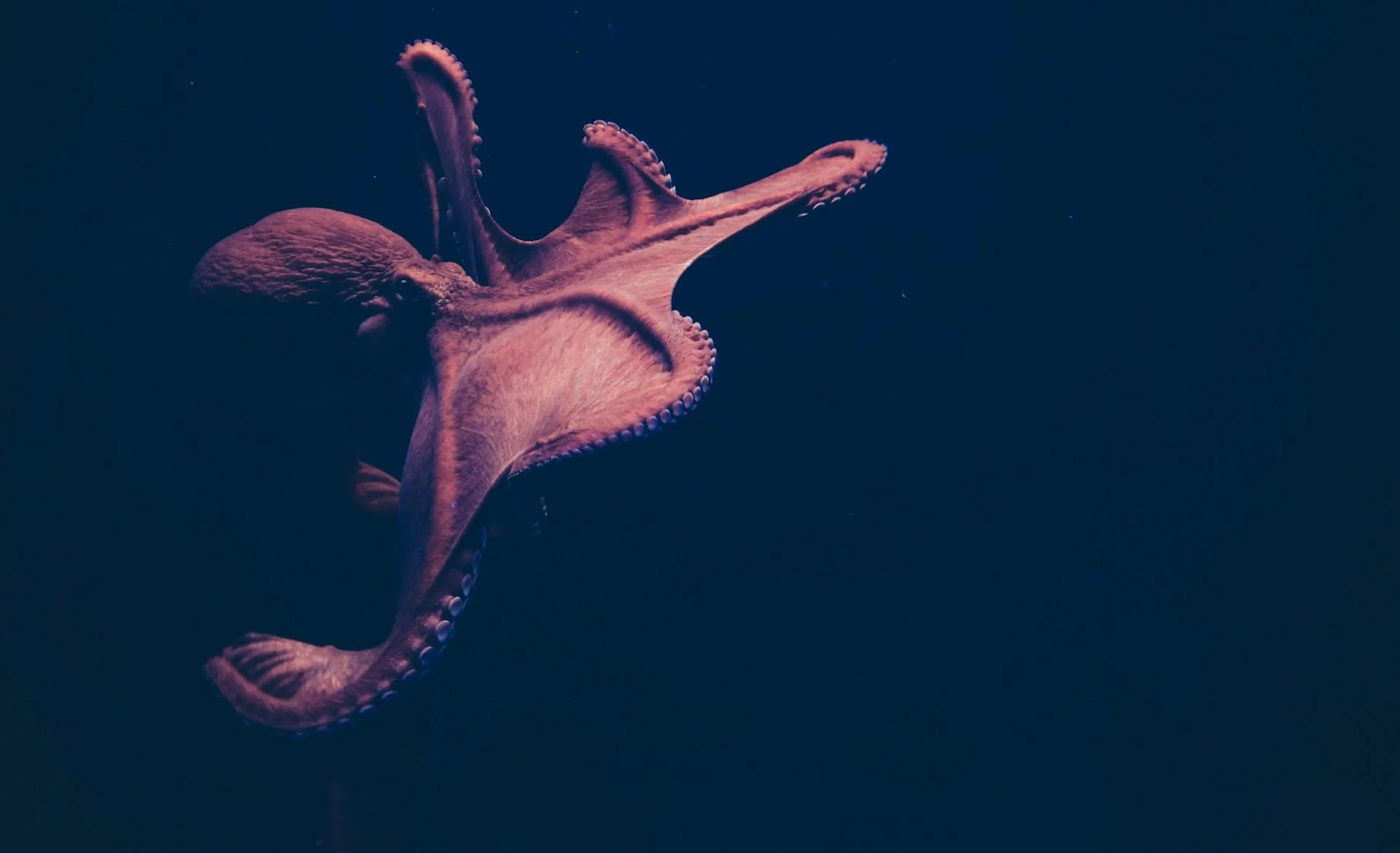
Octopuses, squid and cuttlefish may have evolved large brains because of the challenges posed by their environments rather than the demands of social life, according to a new study published in iScience.
The findings challenge one of the most influential explanations for the evolution of intelligence: the ‘social brain hypothesis’, which argues that larger brains evolved primarily to manage complex social relationships.
While the social brain hypothesis has been widely supported in studies of mammals and birds, researchers found no evidence that social living is associated with larger brain size in cephalopods. Instead, species inhabiting shallower and more complex seafloor environments tended to have larger brains than those living in deeper or open-ocean habitats.
The study, Ecological not social factors explain brain size in cephalopods, analysed data on brain size, ecology, behaviour and life history across 79 species of octopuses, squid and cuttlefish.
Cephalopods possess some of the largest brains relative to body size among invertebrates and display sophisticated behaviours including problem solving, navigation, tool use, camouflage and complex hunting strategies. Yet unlike many mammals and birds, most species live largely solitary lives, with little experience of the demands of social living such as intricate dominance hierarchies and cultural learning.
The researchers found that ecological factors were more strongly associated with brain size than measures of sociality. Species living in shallow habitats on or near the seafloor tended to have larger brains, while species living at greater depths generally had smaller brains. The authors suggest that richer and more diverse environments may offer more calories and create greater cognitive demands by requiring animals to navigate complex habitats, locate food and respond flexibly to predators and changing conditions.
The findings support the ‘Asocial Brain Hypothesis’, which proposes that large brains can evolve in largely solitary species when environmental challenges favour learning, problem solving and behavioural flexibility.
The researchers argue that cephalopods provide a valuable test case for understanding the evolution of intelligence because they evolved large brains independently from vertebrates and followed a different evolutionary path from socially complex mammals and birds.
Principal investigator Michael Muthukrishna, Professor of Economic Psychology in the Department of Psychological and Behavioural Science commented: “For decades the main story of why brains got big has been a social one where bigger brains evolve to manage bigger, more complex groups. Cephalopods reveal that there’s another path to bigger brains. They're often solitary, short-lived, sometimes even cannibalistic, and yet have large brains and intelligent behaviour.
“Our research started with a mathematical model we built years ago to explain human brain evolution that predicted a second path to big brains. Solitary animals could evolve large brains if their environment was rich and complex enough to reward learning. Octopuses, squid and cuttlefish let us test that prediction and the data fit. It turns out there’s more than one path to evolving intelligence.”
Co-lead Professor Jennifer Mather, University of Lethbridge added: “This should remind us that scientific dogma always needs to be questioned, and that once again it shows that cephalopods don’t follow the predictable evolutionary paths.”
The study draws on what the authors describe as the most comprehensive comparative database yet assembled for cephalopod species with available brain data. The researchers say the findings broaden understanding of how intelligence evolves and suggest that environmental complexity may play a more important role in brain evolution than previously recognised.