

Oxford Computational Political Science Group welcomes two LSE Methodology Research Associates
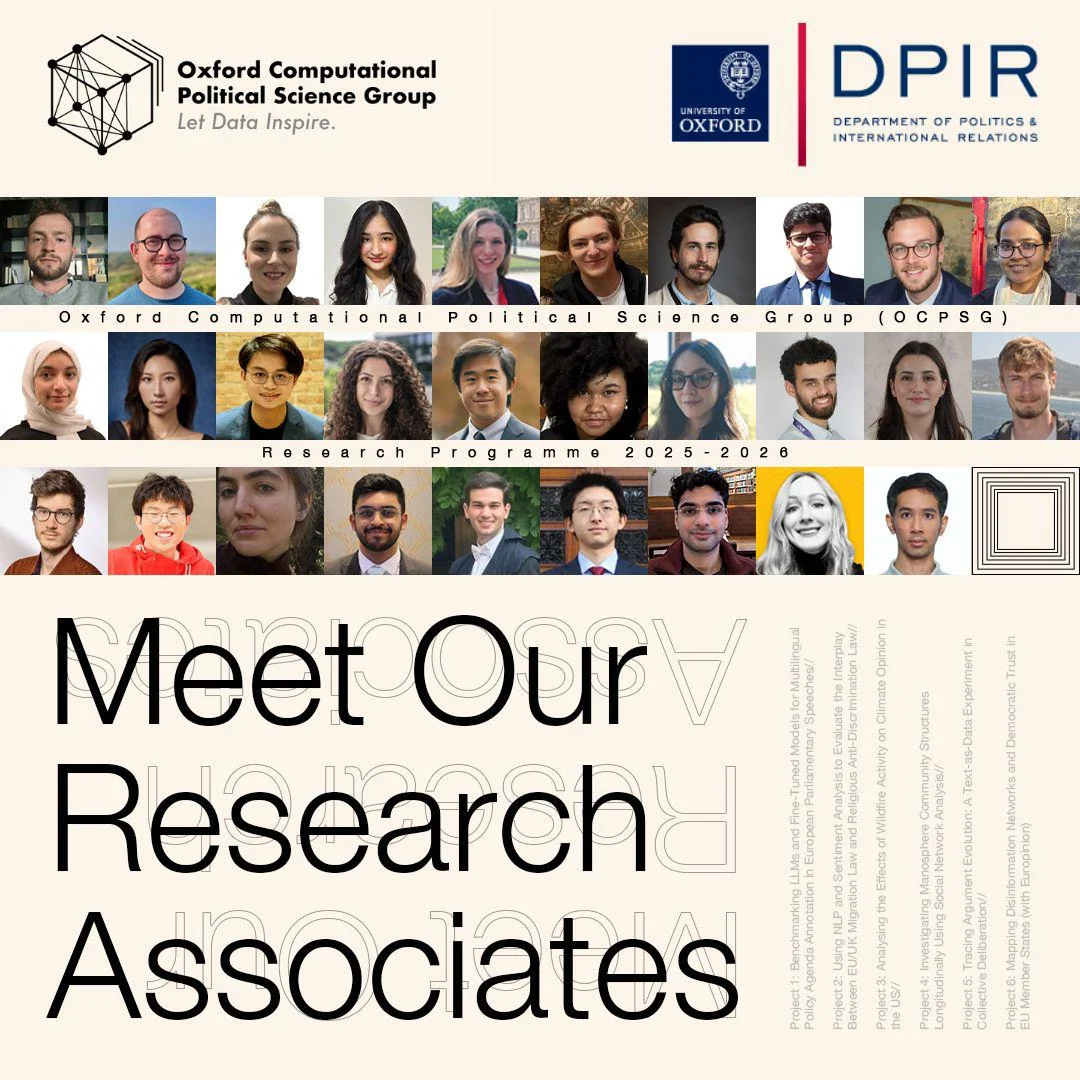
The Department of Methodology is proud to share that two of its' past and present cohort are amongst the newest Research Associates for the Oxford Computational Political Science Group (OCPSG).
This year's OCPSG Research Programme features young professionals, researchers, PhD graduates, graduate students, undergraduate students holding degrees from or currently based in leading universities all over the world, including LSE, Oxford, Stanford, Princeton, Yale, Columbia, NYU, Dartmouth, Sciences Po, University of Zurich, Università Bocconi, University of Antwerp, Universidade de São Paulo, Beijing Normal University, and more.
Project 3 will be led by Stephan Wenninger (LSE Department of Methodology). Project 3 focuses on examining the past and future effects of wildfire activity on climate opinion in the US at the county level. Besides employing statistical inference that allows for cross-sectional and time-sensitive heterogeneity, it also tests different machine learning algorithms to create a forecast of future changes in climate opinion.
Additionally, Ryan Rousseau, MSc graduate in Applied Social Data Science, is part of the research team for Oxford Computational Political Science Group's Project 4.
Project 4, led by Ryan Ratnam (Oxford Internet Institute, University of Oxford / Penn State University), focuses on examining the changing structures of Manosphere communities over a longitudinal period. It employs social network analysis to map Manosphere communities, utilizes survival analysis to predict how long users stay active and the probability of user migration, and leverages interrupted time-series analysis to infer the effects of offline events on the Manosphere’s structure.
The OCPSG is a non-partisan research initiative based at the University of Oxford and supported by the Department of Politics and International Relations, University of Oxford. It is dedicated to advancing the study and application of computational methods in political science. By offering a collaborative environment that blends political science with computational techniques, OCPSG empowers students and researchers to explore innovative solutions to complex political questions.