
Building the European Observatory on Health Systems and Policies

The idea and the founding years
Fenton: Let me take you both back to the very beginning. Where did the idea for the Observatory actually come from?
Figueras: Elias was the first to put the idea very clearly. We were both working in London in the early 1990s, I was at the London School of Hygiene and Tropical Medicine and he was at LSE. Elias had this very strong sense that Europe needed an institution that could systematically analyse health systems and make that knowledge useful to policymakers as well as academics. It was not just an abstract idea. He had identified a real gap, and I immediately recognised that it was the right gap to address.
Mossialos: That is generous of Josep, but we shaped it together. What I had was a frustration and a conviction. There was no serious, sustained effort to analyse and compare how health systems across Europe actually worked. Countries were reforming left and right, especially in central and eastern Europe after the fall of the Wall, but nobody was systematically tracking what was happening, what was working, what was not. The evidence was limited, and scattered across academic journals, much of it unpublished. Policymakers were making major decisions essentially in the dark. I kept thinking: someone needs to build an institution that sits between academia and policymaking and makes this evidence usable.
Fenton: And Josep, you were persuaded straight away?
Figueras: Completely. It was initially Elias and me, joined very early on by Martin McKee, who was crucial from the start. At the London School of Hygiene and Tropical Medicine he was building what became the European Centre on Health of Societies in Transition, ECOHOST, and developing a major programme of research on health and health systems in central and eastern Europe and the former Soviet Union.
What we shared was a sense of urgency. Europe was changing rapidly: countries in the East were rebuilding health systems after Soviet-era structures; western European countries were experimenting with market-type reforms; and the European Union was becoming a force in health policy through internal market law, Maastricht, mobility and regulation. Yet policymakers still had no reliable place to compare reforms or learn from neighbours.
Fenton: You put this idea in writing early on, didn't you?
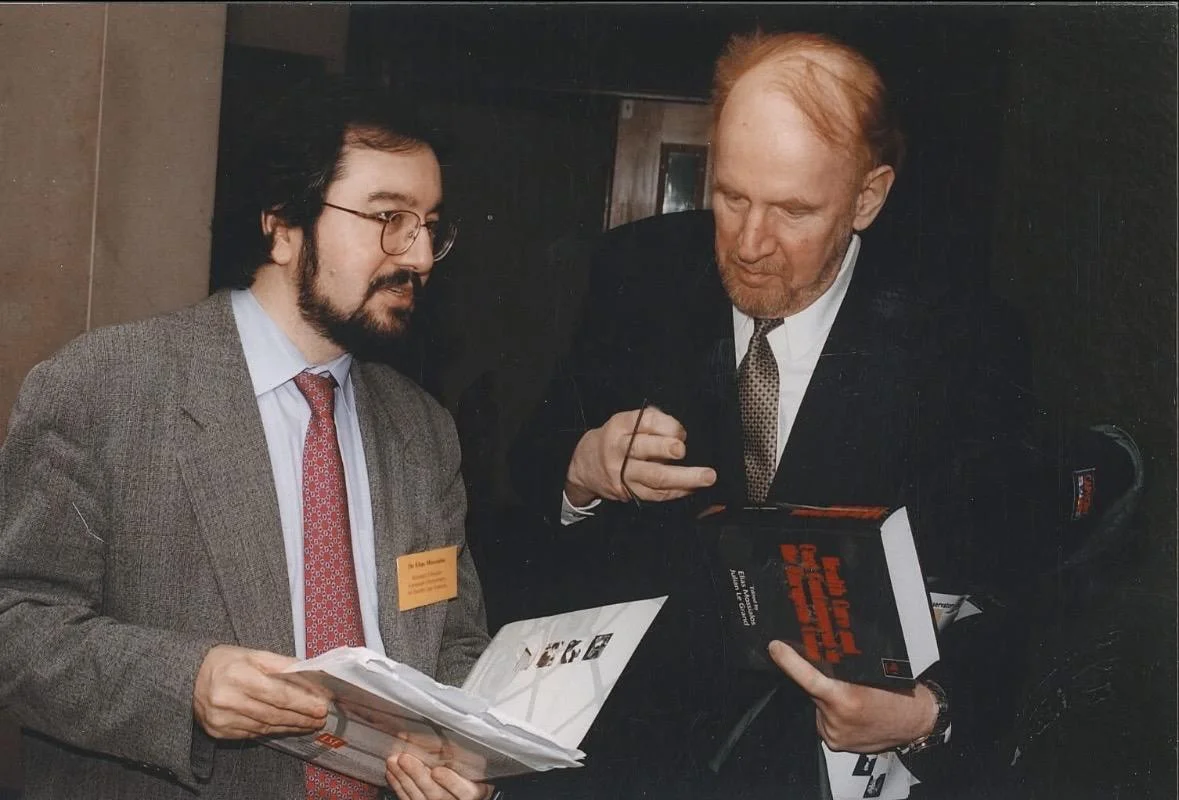
Mossialos: We did. It came together in a book we co-authored with Brian Abel-Smith, Walter Holland and Martin McKee, Choices in Health Policy: An Agenda for the European Union. That book laid out the case for why Europe needed a dedicated institution to monitor and analyse health system reforms.
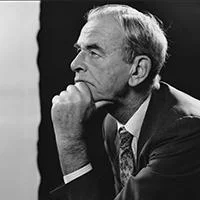
Brian Abel-Smith was an enormous influence on both of us. He understood the politics of health policy like few others, and he could see that the European dimension was going to become critical. In the 1970s Brian had worked closely with the European Commissioner Henk Vredeling on social policy and on controlling pharmaceutical costs. Sadly, Brian died in 1996, before the Observatory came into being. But the intellectual foundations he helped lay were essential.
Fenton: So you had the idea, and you had it in print. What happened next?
Figueras: We tried the obvious route first. We went to our own institutions, LSE for Elias and the London School of Hygiene and Tropical Medicine for Martin and me, and said: this is something we should build here. The response was polite but unenthusiastic. Universities are not naturally inclined to set up operational bodies whose primary purpose is to serve policymakers. Their incentives point elsewhere: towards traditional research, grants and publication impact. The idea did not fit neatly into any existing structure.
Mossialos: To be fair to them, what we were proposing was unusual. It was not a research centre in the conventional sense. It was a knowledge broker, a partnership that would sit between the academic world and the policy world. That is a difficult thing to explain to a university committee. Where does it sit? Who funds it? What are the outputs? These were legitimate questions, and at that point we did not have all the answers.
Fenton: So what changed?
Figueras: I moved to Copenhagen. I initially took a temporary position at the WHO Regional Office for Europe, in the Health Services Department, working with Richard Saltman on the preparations for the WHO ministerial conference on health systems to take place in Ljubljana, Slovenia. The department was led by Constantino Sakellarides, who was deeply committed to supporting reform efforts in countries, under the broader leadership of the Regional Director Jo Asvall.
From inside WHO, the landscape looked completely different. You could see the demand from member states. Ministers were reforming insurance systems, hospitals and primary care while trying to contain costs and preserve equity. Experience was accumulating everywhere, but there was no systematic way to analyse it, compare it and return it to policymakers in a usable form.
Fenton: And that demand became visible at Ljubljana?
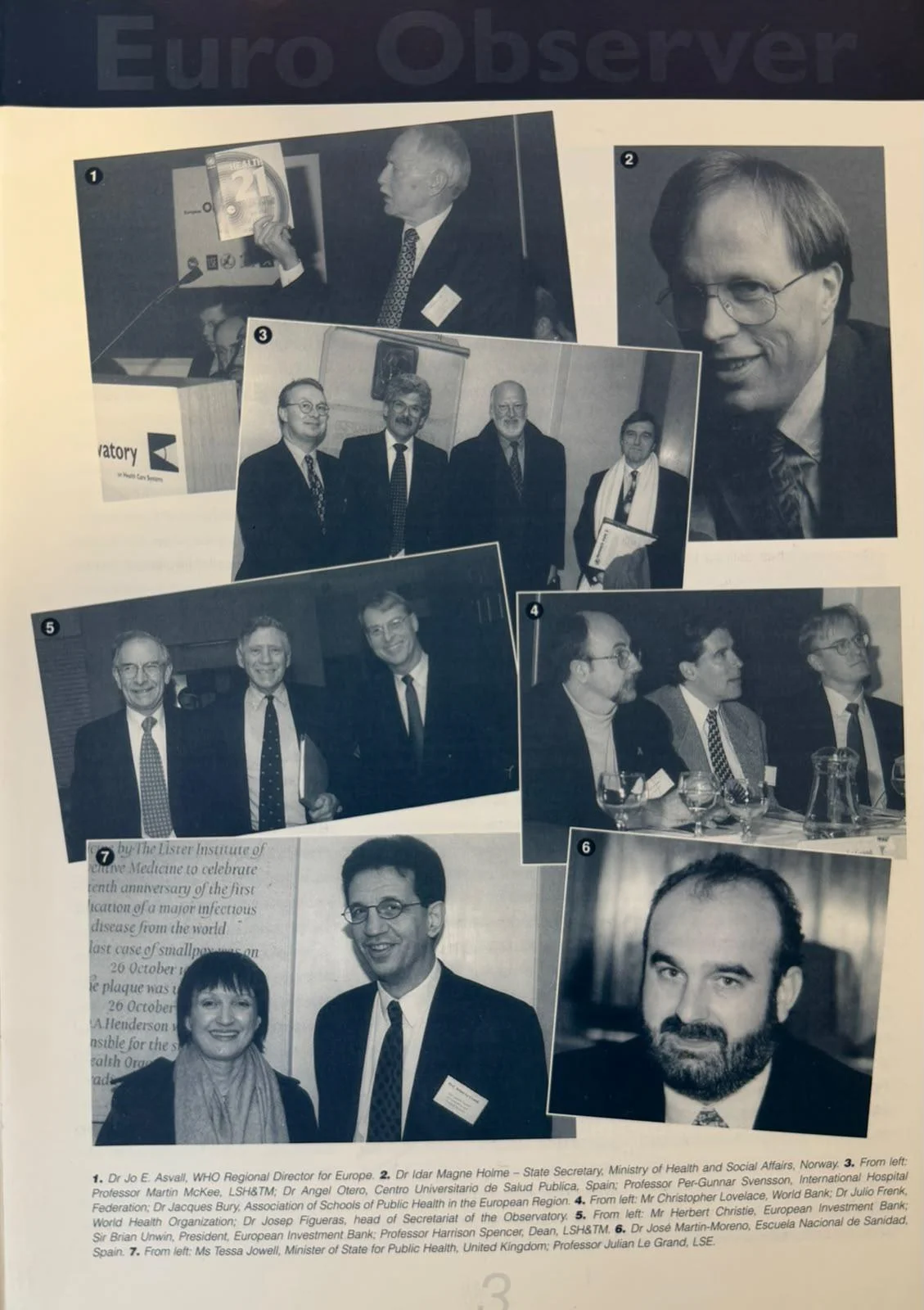
Figueras: Ljubljana was the turning point. In June 1996, WHO convened the first European Ministerial Conference on health systems in Slovenia. Health ministers from across the WHO European Region came together. It was an extraordinary moment. You had ministers from Scandinavian welfare states sitting alongside ministers from countries that had barely begun to dismantle their Soviet-era health systems. And they adopted the Ljubljana Charter, which committed them to reforming health systems around values such as equity, quality, effectiveness and evidence, and to monitoring and evaluating those reforms systematically.
Fenton: What was the atmosphere like?
Figueras: Electric. Slovenia had only been independent for a few years, yet it was hosting a conference where health ministers collectively acknowledged that reform needed evidence. The systems differed enormously, but the questions were shared: how to fund fairly, organise efficiently and know what works. The Charter gave those questions political legitimacy.
Richard Saltman and I were co-leading WHO's study of health care reforms across the region. A core part of that work was the analysis of country health systems through what became the Health Systems in Transition profiles, the HiTs. Martin came to Copenhagen on sabbatical during this period, and Suszy Lessof joined the nascent initiative. With ad hoc country correspondents, they produced a first set of country profiles at remarkable speed. What began as country profiles for the Ljubljana work became one of the Observatory's central pillars, and later evolved into the wider Health Systems and Policy Monitoring network.
Fenton: So you were doing the intellectual groundwork for the Observatory before the institution formally existed?
Figueras: Exactly. Ljubljana showed that there was a real appetite among governments for comparative analysis. The existing infrastructure could not deliver it. Nobody was pulling together the evidence in a way that was timely, independent and directly useful to policymakers. At the end of the ministerial conference, member states passed a resolution for the creation of an observatory, although no resources were attached. But that mattered. We now had both the analytical base and the political mandate to keep making the case inside WHO.
At this stage the work in London was essential. Elias and Martin, with their teams, were leading the research effort effectively pro bono, and Suszy was helping to turn a good idea into a functioning organisation. Without that combination, political demand from member states, research strength from London, and the institutional opening within WHO, the Observatory would not have happened.
Mossialos: What Josep did was absolutely critical. He took the idea we had been discussing in London and gave it an institutional home and a political mandate. The demand was there because Josep and Suszy had helped create it, and because he understood how to translate an intellectual idea into something WHO and governments could actually support.
***
Fenton: And that is where Jo Asvall came in?
Figueras: Jo Asvall was the WHO Regional Director for Europe at the time. He was a visionary, a Norwegian with a deep commitment to equity and evidence. After Ljubljana, the case was clear. I went to him and said: the ministers have committed to monitoring and evaluating reforms; now we need the machinery to do it. We need an observatory, something that watches, analyses and reports on what is happening in health systems across Europe. Not a bureaucratic body, but a lean partnership bringing together governments, international agencies and academic institutions. He understood it immediately. He gave us the green light, and his institutional support to start the initiative.
Fenton: But it was not exactly a lavish launch, was it?
Figueras: Not at all. WHO offered support, but the resources were very limited. We had a small number of governments and agencies willing to come on board; Norway and Spain were among the first, together with the European Investment Bank and the World Bank. And then, ironically, LSE and LSHTM, the same institutions that had not been able to host the idea when we first proposed it from within, agreed to participate as academic hubs. Which made perfect sense. The structure we ended up with was stronger: a partnership hosted by WHO, with academic centres providing the research backbone. It gave the Observatory both political credibility with governments and intellectual rigour.
Fenton: Was WHO entirely at ease with this arrangement?
Figueras: It did not fit neatly with WHO culture or regulations at the time. The Observatory was a semi-autonomous partnership inside WHO. WHO acted as host organisation in legal, administrative and budgetary terms, but the Observatory operated with decision-making independence through a separate Steering Committee, with representatives from each partner. That made some people uncomfortable. We had our own work priorities, our own funding streams and our own publication programme while aligned with the broad mandate and priorities of WHO.
The universities found it unusual as well. We were producing work shaped by policymakers' needs, not only by research council priorities, which was sometimes seen as a lesser form of scholarship. We faced scepticism on both sides: from WHO staff who felt we were too academic, and from academics who felt we were too applied. Open-minded Regional Directors including Jo Asvall, Marc Danzon, Zsuzsanna Jakab and later Hans Kluge gave the hybrid model space to work.
There were also real legal and governance complexities. Three things were decisive in navigating them: Suszy Lessof's institutional work on agreements, governance, operations and quality; Charles Normand's chairmanship of the Steering Committee; and partners who defended the Observatory's independence while recognising WHO's role as host. The lesson was clear: institutions matter, but individuals matter just as much.
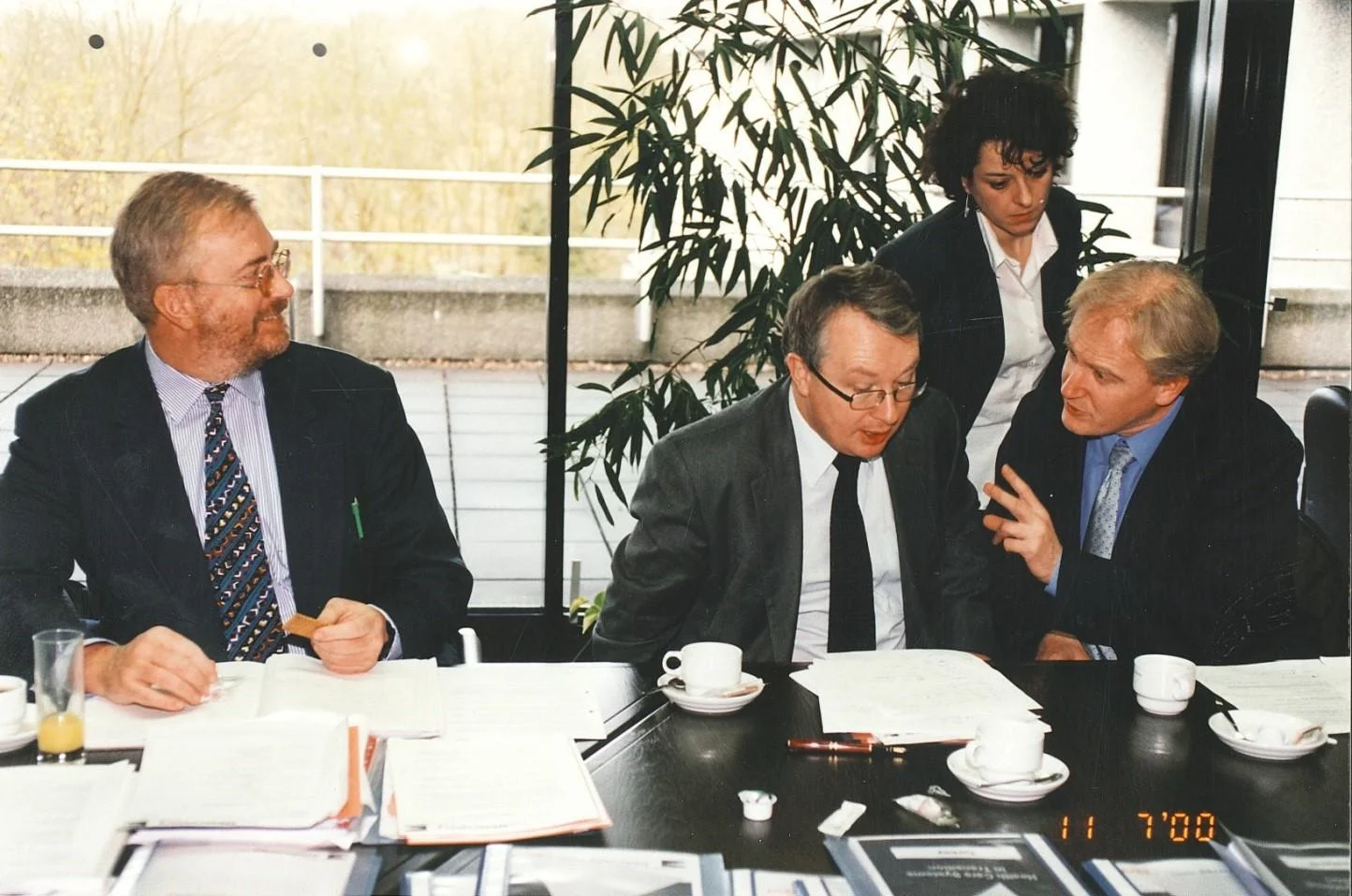
Fenton: Elias, what was the mood when it actually launched in February 1999?
Mossialos: Honestly? A mixture of excitement and anxiety. We had funding secured for three years. Three years. If we could not demonstrate our value in that time, it was over. There was no guarantee this would survive. Josep said something at the London launch that captured the feeling perfectly, he called it "the start of a fascinating development." That was diplomatic. What he meant was: we do not know if this is going to work, but we believe in it completely.
And we did not only have an idea. We had people. We had colleagues, staff and partner representatives who were completely committed to making it work. That mattered as much as the formal structure. The early Observatory was held together by conviction as much as by contracts.
Fenton: What were you most worried about?
Mossialos: Two things. First, relevance. We could produce the most rigorous comparative analysis in the world, but if policymakers did not read it, did not use it, we had failed. The whole point was to bridge the gap between evidence and practice. Second, duplication. There were other bodies in this space, the OECD, the World Bank, various EU actors. We had to find our niche without stepping on toes.
Figueras: I remember being very clear about this from the start. Our focus was not collecting primary data. National statistical offices and international data systems already did that. Our added value was in making sense of the data and the reform experience: collating, analysing, structuring and presenting findings in ways that could be embedded in policy processes. That is a different skill. And it turned out there was enormous unmet demand for exactly that.
From HiTs to Brussels - the model takes shape
Fenton: What was the first real product?
Figueras: The Health Systems in Transition profiles, the HiTs. I had started developing these at WHO before the Observatory formally existed, and they were scaled up substantially around the Ljubljana conference. The idea was simple but ambitious: produce a standardised profile of each health system using a common template, so that policymakers and researchers could compare like with like. By the time we launched, we already had more than thirty completed or underway. They became our calling card. Policymakers loved them because, for the first time, they could see their system described in a structured way and compare it with others.
Fenton: But the HiTs were only one part of the early Observatory work, weren't they?
Figueras: Exactly. The HiTs gave us the country base, but we also needed to compare policy issues across countries. That led to early studies on financing, hospitals, regulation, Central Asia, social health insurance, purchasing, primary care and pharmaceuticals. The point was to take a policy problem and ask: what do different countries do, why do they do it, what are the trade-offs, and what can be learned?
Mossialos: Those books helped establish the Observatory's method. We were not selling a single model. We were developing structured comparative analysis, drawing on country evidence, disciplinary expertise and policy judgement. That approach became the basis for a much larger production of studies, policy briefs and dialogues over the following years.
Fenton: Did you ever think it might not survive those first five years?
Figueras: There were moments. Funding was always precarious. We were building the plane while flying it. But two things saved us. One was the quality of the people. Martin McKee, Richard Saltman, Reinhard Busse, Suszy Lessof and many others brought different perspectives and deep expertise. The other was the demand. Once policymakers started using the HiTs and studies, once ministers and senior officials started calling and asking for advice, the case for our existence began to make itself.

Mossialos: We were very committed and travelling constantly. Natasha Azzopardi-Muscat later wrote about a group of "visionary and passionate young individuals" travelling across Europe to spread the message. That captures something real. We were not waiting in Brussels, Copenhagen or London for the phone to ring. We were out there, building relationships and learning what countries needed.
***
Fenton: You have both mentioned London, Copenhagen and later Berlin. The Observatory's hubs seem to have been central from the beginning. Josep, what exactly was a hub, and why did the model matter so much?
Figueras: A hub was not just an office. It embedded the Observatory in academic institutions while keeping it tied to the policy agenda set by the partnership. The first hubs were at LSHTM and LSE, under Martin and Elias. Then came the Spanish hub, at the Spanish National School of Public Health, supported by José María Martín-Moreno, who later became Director of Programme Management at WHO/Europe and played a key role in the Observatory's sustainability. Reinhard Busse then joined the Observatory, first as head of the Spanish hub and later by establishing the Berlin hub at the Technical University of Berlin. Reinhard strengthened the Observatory's work in health economics, quantitative analysis, hospital performance, DRGs and country analysis, and helped develop a new generation of colleagues including Ewout van Ginneken and Dimitra Panteli. The hubs became research platforms and talent pipelines.
Fenton: Elias, from the London side, how did you see the role of the hubs?
Mossialos: The hubs were indispensable. They gave us an academic environment where we could do rigorous work slightly away from the day-to-day pressures of an international bureaucracy, while remaining closely linked to the Observatory's policy priorities and partners. That combination was unusual and powerful.
It also allowed the Observatory to grow people. The London hubs trained colleagues who later took major leadership roles. Jon Cylus, for example, went on to lead the London hubs, while Sarah Thomson led major work on financial protection and later moved to the WHO Barcelona Office for Health Systems Financing. This is another recurring lesson: institutions survive when they create the next generation.
Fenton: Was it around this period that the Observatory moved its headquarters to Brussels?
Figueras: Yes. Moving the headquarters to Brussels and incorporating the WHO European Centre for Health Policy was strategically important. Belgium, Finland and Sweden joined the partnership in that context. Brussels brought us closer to the European Commission, strengthened our work on public health and European policy, and gave us a stronger platform for dissemination and policy impact.
***
Fenton: By the mid-2000s, the Observatory was up and running, producing HiTs, building its network. But the European Union was also becoming a major force in health policy. Elias, how did that become part of the Observatory's story?
Mossialos: It was never by accident for us. We had been thinking about the EU dimension from the very beginning, it was central to the book with Abel-Smith, Holland and McKee. But for most people in health policy, the EU was almost invisible. Health was supposed to be a national competence. Member states ran their own systems. Brussels had no business telling them how to organise hospitals or pay doctors. And then the European Court of Justice dropped a bomb.
Fenton: The Kohll and Decker cases in 1998?
Mossialos: Exactly. In 1998, two Luxembourg citizens sought reimbursement for healthcare obtained abroad, one for orthodontic treatment, the other for spectacles. The Court of Justice ruled that EU internal market law could apply to these situations, treating healthcare as an economic activity subject to free movement rules. This challenged the assumption that health systems were purely national. If you could buy a car across borders under single market rules, why not a hip replacement? The implications were significant, and many health ministries were unprepared for the shift.
Fenton: And that is where the Belgian Presidency came in?
Mossialos: In 2001, Belgium held the Presidency of the EU Council. Frank Vandenbroucke, then Minister of Health and Social Affairs and currently Belgium's Deputy Prime Minister, understood that something fundamental was shifting. Frank was unusual among health ministers: he had a strong academic background in social and economic analysis and grasped the implications immediately. He did not need to be convinced that EU law was reshaping health care; he could see it himself. That is why he commissioned the work rather than waiting for the problem to become a crisis. I served as a senior adviser to the Belgian Presidency on precisely this question: what does EU law mean for health systems built on solidarity and universal access?
Fenton: Josep, were you involved in this work?
Figueras: Less directly. This was very much Elias's domain, the intersection of EU law, health economics, and comparative health policy. But from the Observatory's perspective, it was critical. It showed that we were not just describing health systems country by country. We could address the big cross-cutting policy questions that no single country could answer on its own.
Fenton: The study became a book?
Mossialos: It did. Martin McKee and I co-authored EU Law and the Social Character of Health Care, published in Brussels in 2002. The core argument was that EU law was reshaping health systems in ways that many health policymakers had not fully grasped, and that there was a real tension between the market logic of the EU treaties and the solidarity principles underpinning European health care. We were not saying the EU was the enemy of public health, far from it. But we were saying that if health policymakers did not engage with EU law, the courts and the market would shape health policy for them by default. We also published an edited volume, The Impact of EU Law on Health Care Systems.
Fenton: It got attention beyond the usual academic circles?
Mossialos: It did. Michel Rocard, the former French Prime Minister and then a Member of the European Parliament, endorsed it. Having someone of that stature say the work mattered helped it travel beyond the usual health policy circles.
We later produced a much more ambitious follow-up: Health Systems Governance in Europe: The Role of European Union Law and Policy, which I edited with Govin Permanand, Rita Baeten and Tamara Hervey. Cambridge University Press published it in 2010, with a foreword by Koen Lenaerts, then a Judge of the Court of Justice and now its President. That gave the work real authority and showed that our analysis was being taken seriously at the highest level.
The through-line, if there is one, is simple: you cannot separate the technical from the political. Health systems are shaped by economic forces, legal frameworks and institutional incentives that conventional health policy analysis can treat as background noise. Getting that institutional analysis wrong leads to reforms that fail in predictable ways.
Fenton: Was there pushback on any of this?
Figueras: Some. The internal market directorate did not always appreciate being told that its policies had consequences for health equity. And from some health ministries, there was wilful blindness, if they ignored the EU dimension, it would go away. It did not.
***
Fenton: You have both stressed analysis. But the Observatory's work was never just analysis. How did the knowledge-brokering side develop?
Figueras: That was a major lesson of the early years. Coming from academia, we initially focused on rigorous, policy-relevant research. But we learned quickly that publication, even policy-relevant publication, is not enough to influence policy. Evidence has to enter the policy process at the right moment, in the right form and with the right people in the room.
So very early on we began developing mechanisms for evidence transfer and knowledge brokering: policy dialogues, policy briefs, rapid evidence responses, tailored presentations to ministries, and closed discussions where countries could explore sensitive issues in confidence. Suszy Lessof, Matthias Wismar and Willy Palm were particularly important in pushing and conceptualising this work. It became core to the Observatory.
Mossialos: That distinction is crucial. A brilliant study that arrives after a decision is useless for that decision. The Observatory's value was that it could combine accumulated evidence with judgement, timing and trust.
Fenton: Looking back at those first five years, 1998 to 2003 or so, what had you achieved?
Figueras: We had survived, for a start. We had proved that the model worked. The HiTs were becoming a standard reference for people trying to understand European health systems. The first comparative volumes were being used by both policy and research communities. The partnership was growing, more governments were joining, we were better integrated with WHO's work, and the European Commission was increasingly engaged. We had also shown that we could tackle politically sensitive questions, such as EU law and health systems, without losing credibility with our partners.
Mossialos: And we had built a team. Martin McKee brought breadth across public health, European politics and research. Richard Saltman brought comparative health systems expertise and a deep understanding of governance. Reinhard Busse brought health economics, quantitative rigour and country analysis. Suszy Lessof was vital in managing the operation, strategy, workplans, governance and collaboration across Brussels, London, Berlin and Copenhagen. The Observatory would not have become what it did without that mix.

Fenton: But still fragile?
Mossialos: Always. Funding was never secure for more than a few years. Any change in political leadership could have threatened our existence. But that precariousness also kept us sharp. We could never take our position for granted.
Tallinn, the financial crisis and the limits of evidence
Fenton: Let's move forward within that first decade. By the mid-2000s the Observatory was established and growing. What came next?
Figueras: Several things happened that increased the visibility and impact of the Observatory. We worked closely with EU Council presidencies, including the Finnish Presidency in 2006 on Health in All Policies and the Slovenian Presidency in 2008 on cancer. Then came the Tallinn Charter in 2008. These were important because they showed that the Observatory could operate at the highest levels of European policymaking, not just analysing health systems, but helping shape the debate.
Fenton: Tell me about Health in All Policies.
Figueras: When Finland held the EU Presidency in 2006, they wanted to put health at the centre of the agenda, not just health care, but the idea that decisions in every sector affect health. Finland asked us to help build the evidence base. The result was Health in All Policies: Prospects and Potentials, with Matthias Wismar playing a central role. It helped give Health in All Policies practical life in Europe, linking it to governance, health impact assessment and implementation.
Fenton: And then Tallinn?
Figueras: In June 2008, WHO/Europe convened the high-level ministerial conference in Tallinn, Health Systems for Health and Wealth. Martin McKee and I played a central role in the analytical work, and the Observatory provided much of the evidence base. The key argument was that health systems are not simply a cost: they contribute to health, employment, productivity, innovation and social cohesion.
Fenton: That sounds obvious now, but at the time it was a contested claim, wasn't it?
Figueras: Very much so. In many finance ministries, health spending was still treated mainly as consumption, a budgetary pressure to contain. We assembled evidence showing that health systems generate employment, support innovation, improve productivity and contribute to social stability. The argument was not for unlimited spending, but that crude cuts could be self-defeating. The Tallinn Charter committed ministers to that broader view just before the financial crisis tested it severely.

***
Fenton: The Observatory's influence also extended into areas such as antimicrobial resistance. How did that develop?
Mossialos: It grew out of work we had been doing at LSE Health on pharmaceutical incentives. In 2009, the Swedish EU Presidency asked us to examine how to encourage the development of new priority antibiotics, after much of industry had walked away. The economics were brutal: antibiotics are taken for short courses, the best new ones need to be held in reserve, and resistance means any drug has a limited lifespan. Everything about the market works against investment.
We analysed more than twenty incentive models and proposed approaches to public-private risk sharing and regulatory reform. The work fed into the EU Council's call for a Commission action plan, and later into the Transatlantic Taskforce on Antimicrobial Resistance. The Netherlands commissioned follow-up work in 2016, Romania's presidency in 2019 drew from the Observatory's work, and Sweden came back again in 2023. Four EU presidencies, fourteen years apart, turning to the same line of work, that says something about the Observatory model. It also says something sobering: the problem is still not solved.
***
Fenton: The Observatory works closely with governments. How do you maintain independence? Is there a tension between being a trusted adviser and an honest broker?
Mossialos: There is no compromise on the principle. We synthesise evidence and present options; we do not tailor conclusions to please a particular government. We try to be a neutral broker, but one that can move quickly without sacrificing quality. That combination is unusual, and it is a large part of why the Observatory has been trusted.
Fenton: The first ten years were clearly challenging and rewarding. But just as that first decade closed, the global financial crisis began. How did that affect the Observatory?
Figueras: It was a testing time. Our immediate fear was that partner governments would withdraw support as budgets were cut across Europe. In fact, many wanted more from us. They were under pressure to make health systems more resilient and efficient without sacrificing equity, and that was exactly the kind of question we were built to address. The crisis, paradoxically, confirmed our relevance.
Mossialos: I would put it more bluntly. Europe was not prepared. The euro had been built with too little serious thinking about what would happen if a member state faced a sustained shock. When the crisis came, the response was improvised, and decisions about health budgets were often taken in finance ministries and the Troika without enough understanding of the likely effects on health systems and health outcomes. Two years after Tallinn, the commitment to treating health systems as an investment came under intense fiscal pressure. The evidence existed, and the Observatory documented it carefully. But the political machinery for using that evidence at European level was weak.
***
Figueras: But something else changed. In 2009, Elias was elected to the Greek Parliament, and in 2011 he joined the government. That was a significant shift. Elias had been central to the Observatory's intellectual life from the beginning. His move into frontline politics meant we had to adapt. The Observatory did not stop, of course, but we lost the daily interaction that had driven so much of what we built together.
Fenton: Elias, did you stay in touch with Josep during that period?
Mossialos: Yes, but not as much as I would have wanted. Politics consumes you completely. Josep kept me informed about the Observatory's work, and he would ask for my views on things. But the rhythm was different. I was no longer in the room in the same way.
Fenton: Did you manage to meet at all?
Mossialos: The experience that shook me most was not academic. In October 2011 I was in Brussels with the Greek Prime Minister, negotiating the bailout. At that level, with the future of a country genuinely at stake, evidence in the usual policy sense had much less force. Decisions were driven by politics, panic and power. Josep and I met that evening, and I told him I was questioning much of what we had built. He reminded me why it mattered. But the doubt has never fully left me, and I think it should not. If you work in evidence-based policy and have never seen evidence fail at the highest level, you have not seen enough.

Fenton: That is a stark thing to admit. Does it not undermine the entire premise of the Observatory?
Mossialos: It should at least unsettle it. I have never found a fully satisfying answer. I came back, slowly, to the counterfactual: without the evidence base, the political room for manoeuvre is even narrower. But that answer should not become too comfortable. Institutions like the Observatory need to keep asking whether evidence is actually entering decisions, and where it is not. I think the Observatory is genuinely valuable, but anyone running it should sit with that doubt rather than resolve it too neatly.
Fenton: But did the doubt come back? Because the obvious question is: if evidence struggles to get a hearing when the stakes are highest, what is the point of an observatory?
Mossialos: It did come back. During the austerity years, governments often cut health budgets in ways that ran against the evidence. The Tallinn Charter said health systems are an investment, not simply a cost, yet finance ministries still cut because they were under pressure or believed they had no room to do otherwise. I kept returning to the counterfactual: evidence does not always win, but without it you do not even have an argument.
Figueras: I would go further. There were moments when governments, including sometimes partner governments, were uncomfortable with what we published: on inequities, access problems, hospital inefficiencies, weaknesses in primary care or pharmaceutical pricing. We had difficult conversations, but we never changed findings to suit a member state. That was a line we would not cross.
And in many cases, the relationship survived, even strengthened, because governments realised we were not there to flatter them. If we had pulled punches, we would have lost credibility. Maintaining independence inside WHO was not always easy, but WHO understood the nature of the partnership and gave us space to do our work.
Fenton: Can you give a concrete sense of how these tensions played out around the HiT profiles?
Figueras: The most common difficulty was when a government announced a reform and we needed to analyse it, but we had reservations about whether it would work. In those cases, governments sometimes pushed back, gently or more forcefully, depending on the country and the moment. We learned to present reservations as prerequisites for successful implementation rather than as attacks on the reform. A careful reader would understand the warning. The framing was diplomatic, but the substance was preserved. That kind of navigation is invisible from outside, but it was a constant part of the work.
Fenton: You mentioned Martin McKee's work during the austerity period. Can you say more?
Figueras: Martin did something that took real courage. While governments were insisting that austerity was not harming health, he published evidence linking austerity to deteriorating access to care, cuts in harm reduction and other damaging outcomes. Some governments, including partners, were uncomfortable. Martin did not tone it down. That willingness to follow the evidence wherever it led was part of what made him indispensable to the Observatory.
Fenton: Looking back across that first decade and its immediate aftermath, what would you say the Observatory achieved?
Figueras: Zsuzsanna Jakab, when she was WHO Regional Director for Europe, said at our twentieth anniversary that the Observatory had been ahead of its time in bringing together governments, academics and international organisations. I think that was right. We built a form of collaboration that did not really exist before, and it proved more necessary than many of us expected.
Reflections, reckoning and the road ahead
Fenton: Nearly three decades on, what has the Observatory become?
Figueras: Something much larger than we imagined. It began as a fragile experiment with three years of funding and became an institution with real impact on how governments think about health systems. The HiTs evolved into health system reviews and performance assessment tools; studies, policy briefs and rapid responses are widely used; the model inspired observatories elsewhere; and the networks of country experts, policy partners, academics and practitioners became a genuine intellectual community.
Fenton: And what was the hardest thing about holding it together?
Figueras: The partnership model itself. Governments, national institutions, universities and international agencies have different incentives and cultures. But those differences are a strength if you can hold them together. Maintaining that combination through changes of government, funding crises and political pressure was the hardest thing we achieved. I am fully confident the Observatory will not only continue but thrive.
Mossialos: I would add one point about the future. The Observatory should keep its edge. It should remain close enough to governments to be useful, but independent enough to say uncomfortable things. That balance is what made it valuable in the first place.
Fenton: Josep, who picks this up?
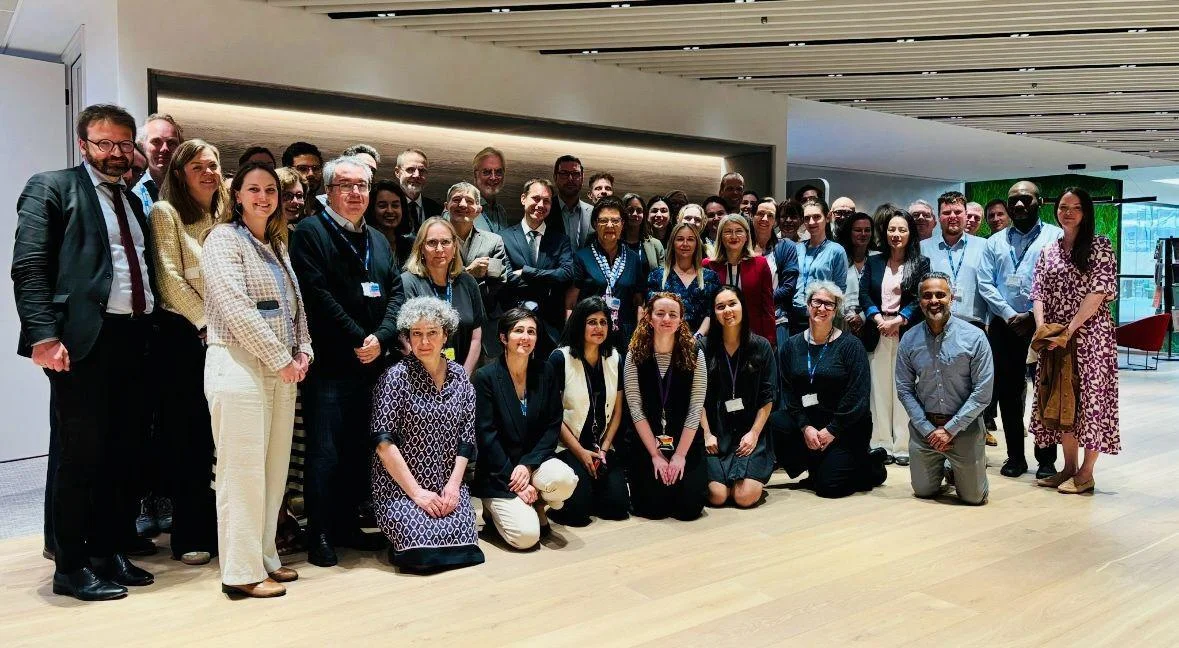
Figueras: That is what gives me real confidence. Ewout van Ginneken, who has succeeded me as Director, is outstanding, rigorous, internationally respected and deeply committed to the partnership model. Suszy Lessof as Deputy Director continues to be the institutional backbone. Dimitra Panteli, Matthias Wismar, Jonathan Cylus, Dheepa Rajan and many others now lead major streams of work. With the hubs in Brussels, London and Berlin, the country networks and the wider community of partners and experts, the institutional depth is genuinely there.
***
Fenton: But it was not always easy within your own institutions, was it?
Mossialos: No. We went through rough times even within universities, because this work was not seen as purely academic. Producing accessible evidence for policymakers could be treated as a lesser form of scholarship. Some colleagues questioned whether Observatory publications should count in research assessments. We were often too applied for academics and too academic for bureaucrats.
Fenton: Do academic incentive structures work against this kind of engagement?
Mossialos: Completely. University rankings, promotion criteria and research assessments still revolve largely around journal citations. Policy impact is harder to capture. When you spend months advising a government, very little of that appears in a conventional academic record.
I will be honest: there were times I questioned that trade-off. Every hour advising a government was an hour not spent writing for a leading journal. But then you would see a recommendation reflected in policy, or hear a minister say the evidence had changed how they thought about a problem, and you were reminded why the work mattered.
Things have changed somewhat. The UK Research Excellence Framework now includes impact, and funders increasingly ask what difference research made beyond academia. The Observatory was doing that kind of work before it became fashionable. But the deeper problem has not gone away. Promotion panels still reward papers in high-impact journals, while policy impact remains harder to recognise. Younger colleagues feel this most acutely: they want to do policy-relevant work, but they also need to build academic careers. That is one reason this kind of work remains fragile, and why it still depends on people willing, at certain moments, to trade some conventional academic reward for influence on real decisions.
***
Fenton: One thing that comes through in everything you have described is speed. EU presidencies calling with months to deliver, governments wanting answers to live policy questions. That is not the normal rhythm of academic work. How do you manage the tension between rigour and urgency?
Mossialos: You have to accept that you are not always writing the definitive study. You are providing the best available evidence at the moment a decision has to be made. A presidency lasts six months; a minister may have only a short window to get something through cabinet. If you say "come back in two years when the systematic review is finished," they will decide without you. So the question is not whether the advice is perfect, but whether it is better than what the minister would otherwise have.
There are risks. You can get something wrong or miss a nuance that matters. But the greater risk is silence, leaving policymakers to rely on ideology, anecdote or lobbying. Our job is not to deliver certainty. It is to reduce the uncertainty policymakers face, and to do so on their timeline, not ours.
Figueras: Speed is also a muscle you develop. You can be fast and rigorous if you have already invested in understanding the evidence base. When a country called, we did not start from zero. We had years of accumulated knowledge, expert networks and studies behind us. The rapid response was only the visible part. Underneath it lay years of groundwork.
***
Fenton: This raises a broader methodological question. In medicine, the randomised controlled trial is treated as the gold standard. But in health systems policy, you cannot easily randomise countries. So what counts as evidence in your work?
Mossialos: This is fundamental. Angus Deaton and Nancy Cartwright have argued that RCTs are often given too much authority, that a trial can tell you what happened in a specific setting, but not necessarily why, and that external validity is much harder than people assume. In health systems, this is obvious. You cannot randomise a country into adopting diagnosis-related groups or choosing one financing model over another. These decisions are too large, too political and too embedded in institutional context.
For the biggest questions, evidence usually comes from structured comparative analysis: multiple countries facing similar problems, with careful attention to institutional, political and economic context. We try to identify patterns and mechanisms, under what conditions does a reform work, where has it failed, and why? That is often closer to comparative political science than to clinical trial methodology, and more useful to a health minister deciding among real-world options.
Figueras: And even when trials are feasible in health services, say, testing a new way of organising primary care in a district, the results are almost always context-dependent. What works in a well-funded Swedish municipality may not work in a resource-constrained Romanian region. So we do not just ask, "Did this intervention work?" We ask, "Under what conditions, in what institutional setting, with what resources and political support?" That is the far more useful question for policymakers. It is also why policy dialogue matters. The success of an Observatory policy dialogue depends not only on the quality and relevance of the evidence, but on understanding the policy environment and tailoring the discussion to it.
Mossialos: I would add something here, because it sometimes attracts criticism from colleagues in academia. It is more comfortable to be critical from the outside than to build solutions from inside the room. Critique is essential, it puts pressure on governments, exposes failure, protects the public interest. But critique alone is not enough. Someone has to do the slower, less rewarded work of designing what comes next, sitting with officials who have to implement it, and adjusting it when reality bites. That is where the Observatory chose to operate, and it carries a real risk: the closer you work with governments, the easier it is for your independence to be questioned. Helping to build solutions does not require giving up a critical perspective. It requires holding the two together, which is harder than doing either one alone.
***
Fenton: Let me put a practical question to you. A former student calls and says: I have just been asked to advise a government on health system reform. What should I read first?
Mossialos: I would tell them not to read a health systems book. Not first. Read a good history of the country, its politics, its culture, how power works there. A health system does not exist in a vacuum. The Beveridge model did not emerge because someone designed an optimal financing structure. It emerged from wartime solidarity in Britain, from a particular political moment. The Bismarck model emerged from completely different political calculations. If you walk into a ministry without understanding why the system looks the way it does, you will produce advice that is technically correct and practically useless. The technical literature comes second. You start with context, because context determines whether any reform will fly or crash.
Figueras: I agree, and this connects to how the Observatory differs from consulting firms. Large consultancies often arrive with a standard methodology and confident recommendations based on international best practice. Sometimes that is useful; often it is not enough. Health system reform is not simply a technical problem with a technical answer. It is a political and institutional problem that requires judgement, local understanding and humility. We do not arrive with ready-made answers. We arrive with evidence, options and the experience of what has happened elsewhere. We try to clarify trade-offs. That is less reassuring to a politician who wants certainty, but it is more likely to lead to a reform that will stick.
Mossialos: That is also why the Observatory has lasted. We build long-term relationships. We come back. We are a partner, not a contractor.
***
Fenton: We have heard a lot about the successes. But have there been moments where the work simply did not land, or where you faced outright hostility?
Mossialos: Yes, and it would be dishonest to pretend otherwise. You are entering someone else's territory. Not every politician welcomes that. A defensive government, or a minister who has already decided what to do, creates a very different room. And you often do not know which room it is until you are in it.
I have been invited to present to a minister and before I have even started received the pushback: "Why are you here? There is nothing for us to learn from you." In that moment you could challenge the minister in front of officials, and the meeting would be over. So instead you absorb it. You say: "Of course, Minister, you know your country far better than I do. But I can share what a few other countries have done when facing similar questions, if that is useful." You give them the option to re-engage on their own terms. Sometimes it works. Sometimes it does not. I have had a minister walk out of the room. You learn from it, but you accept that not every engagement will succeed.
Figueras: The Observatory has faced similar moments. There were times when a HiT profile or policy study said something a government did not want to hear, perhaps about inefficiency in hospitals or weaknesses in primary care, and the response was not always gratitude. In those moments, the temptation is to soften the message. Careful wording is sometimes appropriate, because precision matters. But there is a line between being fair and being dishonest, and we never wanted to cross it. Another part of impact is identifying the real policy windows, the honeymoon moments when a new government or minister is open to advice, and proactively offering evidence then. That is when you have the greatest chance of shaping a reform before positions harden.
Fenton: Beyond those confrontational moments, have there been cases where the Observatory's advice or analysis turned out to be wrong, or where a reform you supported did not deliver what was expected?
Figueras: We would be lying if we said no. Health system reform is inherently uncertain. You can assemble the best evidence and still be surprised, because implementation is messy, political circumstances change and economic conditions shift. We have seen reforms that looked sound on paper falter because institutional capacity was weak or the political coalition collapsed. And sometimes the most useful thing we did was to help stop a reform that might have damaged the health system. What matters is being honest about limits. We do not claim to predict the future. We try to set out evidence, options and trade-offs as clearly as we can. When something does not work, we go back and ask why. Failure in one country becomes a lesson for the next.
Mossialos: And sometimes the measure of success is not that you solved the problem but that you stopped it from being ignored. AMR is a case in point: four EU presidencies, nearly two decades of work, specific recommendations implemented, but the core problem is still not solved. The evidence was right. Some of it was taken up. But the structures that make antibiotic development unattractive are deeply entrenched. That is humbling. But without the work, the situation would be worse.
***
Fenton: One final question. AI can now synthesise comparative health systems data in seconds, generate policy briefs and analyse reform options across dozens of countries. Does the Observatory still have a role?
Figueras: More than ever. AI will make some analytical work faster, and the Observatory will use it. But a minister facing a difficult reform does not need a faster literature review. They need to know which reforms have been tried in comparable settings, why they succeeded or failed, and how local politics will shape the options. That requires something AI cannot yet replicate: accumulated institutional knowledge combined with human judgement about what will actually land.
Mossialos: There is also a structural problem. AI systems are trained disproportionately on material from a small number of high-income countries. Ask them to advise on reform in Georgia or Indonesia and they may default to patterns drawn from very different settings. The risk is a confident recommendation grounded in someone else's reality. The Observatory exists because one size does not fit all.
And there is something AI cannot do at all, which is build the relationships that make policy work travel. Ministers and civil servants take advice from people they trust, and trust is built over years of showing up, getting things wrong, and being honest about it. That is the institutional memory the Observatory carries. It is not a database of past reports. It is a network of people who have argued with each other for two decades about what good evidence looks like and what to do with it. That is why the Observatory's role is not diminishing. It is becoming more important.
***
Fenton: Josep, any final thoughts?
Figueras: That institutions are made by people, not by organograms. You can have the best design in the world on paper, but if the people do not believe in it, it will not work. What made the Observatory at the outset was that a small group of people, Elias, Martin, Suszy, Reinhard, Richard and many others believed that evidence could make health systems better, and were willing to devote years to proving it. But it was also the people in the Steering Committee: they worked through bureaucratic and political complexities in their own institutions to keep supporting us. We did not always agree, but the debate and consensus-building made the Observatory stronger. The other lesson is the value of being useful: when something you have written changes how a minister thinks about a problem, that may matter more than a journal citation.

Fenton: Elias, a final reflection before we close?
Mossialos: If I had to add one reflection of my own, it would be this. The hardest thing in this field is not generating evidence. It is keeping intellectual honesty when the political pressure points the other way. Across thirty years I have watched governments reach conclusions before the analysis was done. The discipline of saying what the evidence actually shows, even when it is unwelcome, is harder than it sounds.
But there is a second concern that worries me more, and it concerns my own community. Academic health policy can become too risk-averse. Too much work is incremental. The genuinely big questions, how to finance health systems under demographic pressure, govern health in a fragmenting international order, respond to climate change, use AI responsibly, address structural inequality, require bold, integrative and sometimes unfashionable thinking. The Observatory should remain one of the places where those questions can be asked seriously.
That is what I hope the next generation will carry forward, in the Observatory and beyond: the willingness to ask the questions that actually matter and to follow the evidence even when the field would prefer something tidier. I have not always managed it. That is the discipline I would most want passed on, not as an ideal I embodied, but as one I kept falling short of and returning to.
Figueras: Let me end where Elias began, with the people. The Observatory was never a building or a budget line. It was a community of people who believed that good comparative work could make health systems better, and were willing to put in the years to prove it. That community is larger now than it has ever been, and it extends well beyond the names we have managed to mention here. If the next generation keeps faith with that, the rest will follow.