
From Houghton Street to the Indian Ocean: how LSE alumni and academics helped shape a nation

When Professor Tarun Khaitan landed in Mauritius in September 2025, he arrived with an invitation that carried an unusual kind of weight. LSE alumni in Mauritius had asked him to lecture on constitutional reform, in a country whose founding constitution had itself been shaped by an LSE academic decades before him and where LSE alumni impact every level of society.
Professor Khaitan holds the same Chair of Public Law at LSE Law School that Professor Stanley Alexander de Smith held when he helped draft that constitution in the late 1960s. With roughly six decades between that significant moment and Professor Khaitan’s visit, one thing is clear, LSE's relationship with Mauritius is not just a historical footnote. It is living and active.
A constitution, a president and a prime minister
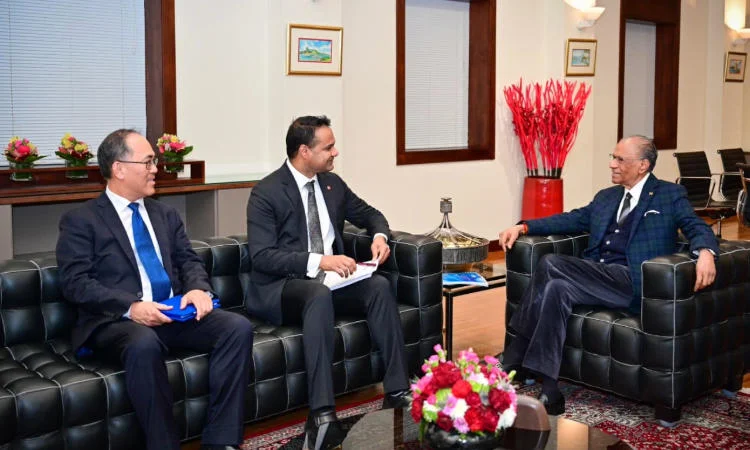
The story of LSE and Mauritius is, in many ways, a story told through individuals. Two of the most significant figures in the country's modern history, the first President of Mauritius and the current Prime Minister, are both LSE Law School alumni.
Sir Veerasamy Ringadoo (LLB 1948) was the first President of Mauritius, a man whose connection to LSE proved formative. Navin Ramgoolam (LLB 1990) is the current Prime Minister, an LSE alumnus now leading the country at a moment of significant constitutional and electoral debate.
The institutional thread that connects them runs through Professor de Smith, whose role in drafting the Mauritian constitution at independence made LSE's contribution to the country something deeper than a matter of student enrolment. When Professor Khaitan returned to that same constitutional conversation last year, the resonance of de Smith's legacy was felt directly.
Founded by a president, sustained by a community
In 1992, at the personal initiative of Sir Veerasamy Ringadoo, the Mauritius LSE Society Trust Fund was established, not by a simple administrative act, but by Act of Parliament. That a national legislature saw fit to enshrine an alumni society in law speaks to the depth of regard in which LSE is held across the island.
Today, around 305 LSE alumni call Mauritius home. The society has been led since 2010 by John Chung (BSc Management Sciences 1991), who has built a warm and consistent relationship with LSE's alumni team in London.
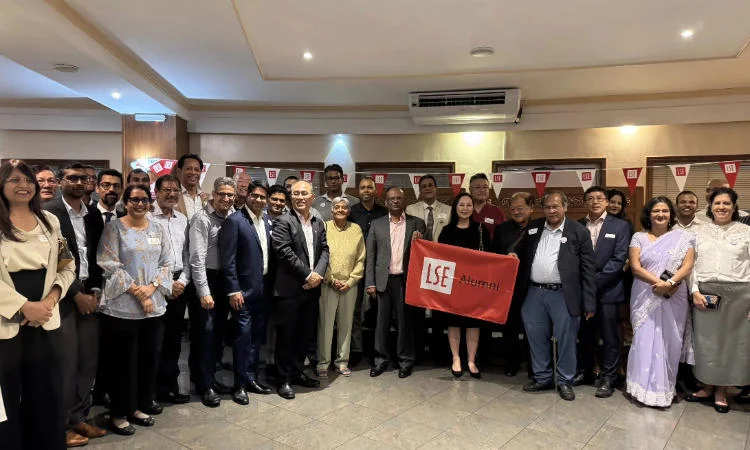
John Chung has led the Mauritius LSE Society Trust Fund since 2010. On what that relationship represents, he says:
The post-Independence history of Mauritius has been influenced at the highest level by the LSE Law School: from Professor Stanley de Smith to Mauritian alumni, including the Prime Minister, former Central Bank Governor, former Deputy Prime Ministers, current Ministers, Judges and Senior Counsels. We also acknowledge the contribution of all the visiting academics from the Law School, invited by the Mauritius LSE Society Trust Fund. We look forward to further exchanges with the Law School, involving consultancy and joint research, to consolidate the rule of law in Mauritius.
More than membership
What makes the Mauritian alumni community distinctive is not its size, but its ambition. The Mauritius LSE Society Trust Fund does more than just engage with fellow graduates. It actively invests in the relationship, year after year, in ways that go well beyond most alumni associations anywhere in the world.
Each year, the society fundraises to bring an LSE academic to Mauritius for a week of lectures for local universities and alumni. The visit is funded locally, organised locally, and driven by the community's connection to LSE. Members also participate in global programmes including Welcome to the City and Global Networking Night.
An active and current conversation
By the time Professor Khaitan arrived in Mauritius on 22 September 2025, the country was at a pivotal moment. The government had announced a major review of the constitution, and the alumni community had reached out to LSE Law School to ask if the current Chair of Public Law might come and contribute to the national conversation.
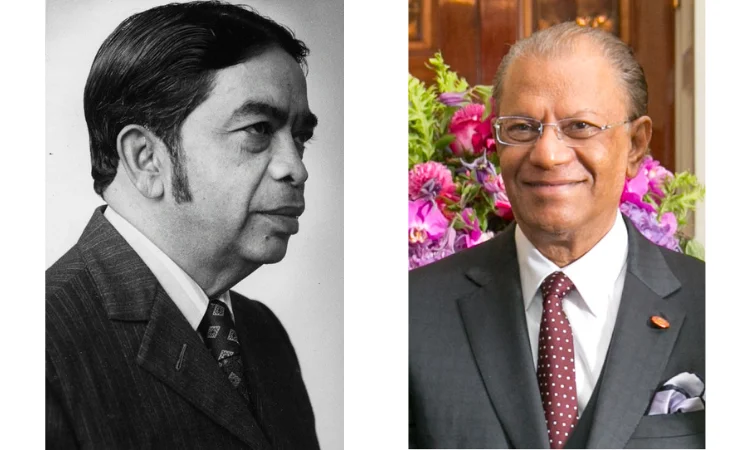
Over five days, Professor Khaitan delivered a keynote lecture, Constitutionalism in Mauritius, at the University of Mauritius, and spoke at the Institute of Judicial and Legal Studies on Constitution making and the Principle of National Consensus. He met with the Prime Minister, ministers, judges of the Supreme Court, senior civil servants and academics, as well as LSE alumni across the island.
Professor Tarun Khaitan reflects on what the visit meant, and on the legacy that preceded him:
Mauritius has a very interesting constitutional history, and I have been teaching its unique ‘best loser’ electoral system at the LSE. To be invited there by the alumni community at a moment when the country was considering its constitutional future was a rare privilege. The Chair of Public Law at LSE carries a connection to Mauritius that predates my own time in it by decades, through my predecessor Professor de Smith’s contribution to its constitution. I hope, in some small way, I was able to pay tribute to the LSE’s long engagement with constitutionalism in this remarkable island democracy.
The next generation
The relationship between LSE and Mauritius is also investing in new generations. An undergraduate scholarship for a student from Mauritius is among the most tangible expressions of a bond that continues to renew itself.
Decades on from the drafting of a constitution, from the founding of a republic and the graduation of its first president, the conversation between LSE and Mauritius is as active as it has ever been. A prime minister who studied on Houghton Street now leads the country. The current Chair of Public Law has lectured in its capital, and the alumni community that shaped all of it continues, quietly and deliberately, to sustain the bond.
Read more stories from LSE's global alumni community.
June 2026