

The Phelan US Centre PhD Summer Research Grants

Our summer research grants encourage innovative research on the United States and supported students pursuing postgraduate research on topics related to the Centre’s overall mission of promoting internationally-oriented scholarship on America’s changing role in the world.
If you need to travel to the US for research, this grant is for you. I would highly recommend applying! - Marral Shamshiri-Fard
The Summer Research Grant programme is a wonderful opportunity for young researchers to develop grant work experience" - Ariel Perkins
The Summer Grant scheme is open to all LSE PhD students who are conducting US-related research, however, research proposals should fall under one of the US Centre’s core research themes.
The 2018/19 academic year was the first year for the Summer Grant scheme. This programme has been run subsequently in the 2019-20 and 2020/21 academic years.
Read the donor and programme reports below for more information on the programme. You can also read more about how the programmme supported early career research here.
For information on the current programme please click here.
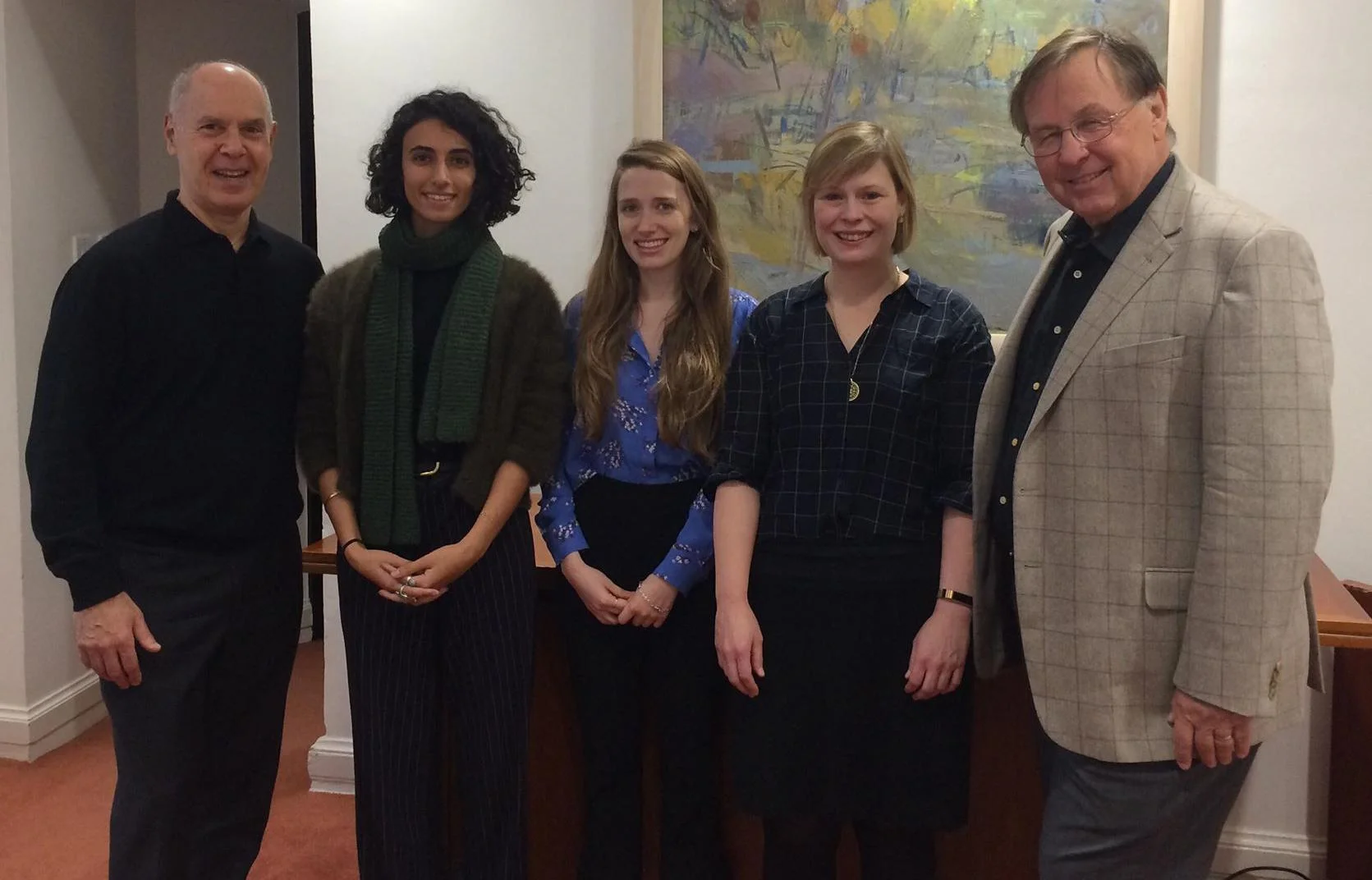
US Centre Director Peter Trubowitz with 2018-19 PhD Summer Grant recipients Marral Shamshiri-Fard, Jacklyn Majnemer , and Ariel Perkins and the programme donor Dr Harold Glass.
Previous projects supported by US Centre PhD Summer Research Grants
Research Projects 2024/25
Jack Roush, Department of International History
My PhD dissertation examines the role of informal actors in relations between the United States (US) and Iran between the 1946 Soviet withdrawal and the 1979 revolution. It utilises a range of sources (in both English and Persian) to analyse how a transnational network of Pahlavi courtiers, US arms and oil industry executive, and international financiers shaped diplomatic initiatives and significant policy decisions. Specifically, it engages with US-led development projects in the 1940s, Iran’s evolution into a US security partner through the 1960s, Iranian investment and formation of a political lobby in the US, and efforts to protect the Shah after the revolution. It seeks to transcend long-standing assumptions in the field, regarding patron-client dynamics between the US and Iran and the primacy of the Shah within Iranian politics.
Through this approach, my research also offers insight on broader themes in the study of the global Cold War. By adopting a pericentric framework, it demonstrates how small states like Iran influenced the actions and objectives of powers like the US. Furthermore, it seeks to demonstrate the importance of both ideological considerations and economic interests in US policymaking during the Cold War and examine the tensions between the two. Ultimately, by de-centring formal policymakers, my dissertation offers a unique account of a significant bilateral relationship in Cold War history and evaluates its implications for later decades.
Based on these objectives, my research is guided by the following core questions:
• What role did informal actors have in Iran-US relations?
• Did informal actors act according to their own agency, or were they beholden to state interests?
• How can formal/informal politics be conceptualized?
• How does the study of informal actors affirm or challenge the assumption that Iran was a US client state?
Click here to read the report.
Daniele Sudsataya, Department of Health Policy
My PhD thesis investigates the heterogeneity in vaccine uptake and vaccine incentive receptiveness observed during the COVID-19 pandemic in the US, where public opinions were being fragmented due to the politicization of health matters, proliferation of misinformation, and lack of institutional confidence (Kriss, 2022). As prior research has scarcely considered the role of an individual’s core values in shaping their vaccination choices, I will explore this idea in three papers.
The first paper will investigate the role political core values play in influencing an individual’s receptiveness to different COVID-19 vaccination incentives during the pandemic in the USA. By parametrizing the cost of getting vaccinated, I will analyze the trade-off between money and the cognitive cost that may occur when an individual engages in an action (in this case vaccination) that can signal political group norms during the COVID-19 pandemic.
The second paper assesses whether insurance as a monetary incentive played a role in influencing COVID-19 vaccination. During the pandemic, five US states expanded their Medicaid program to cover individuals of a certain household income bracket under the Affordable Care Act. I will compare differences in COVID-19 vaccine uptake in states before and after expanding Medicaid coverage to states that did not expand. As this program was a flagship policy of the Obama administration, political core values may be a potential effect driver.
The third paper will investigate an observed ethnic minority gap in COVID-19 vaccination uptake in in the US (Fuller et al., 2021). Focusing on ethnic group membership, I will elicit if the heterogeneity in individuals’ receptiveness to COVID vaccine incentivization policies was impacted by community-driven norms, perhaps passed down through shared experiences, with one example pertaining to the Tuskegee Syphilis Study (Alsan and Wanamaker, 2018).
Click here to read the report.
Arianna Parisi, Department of International History
My PhD thesis explores Black abolitionist feminism and aims to investigate how it developed and evolved in the United States. Rather than prison abolitionism being viewed as a primarily contemporary movement, it has a much longer history that can be traced back to the work carried out by Black feminists in organisations against gender violence in the 1970s. It can also be traced back to the 1971 Attica prison riot and the wider response to the war on drugs of the 1980s and 1990s. The project investigates prison abolitionism considering Black women’s essential contribution to developing the theory and being important participants as activists in the larger movement from the beginning. This necessity arises from the fact that traditional historiography has generally neglected Black women’s political influences and contributions in the history of the Civil Rights Movement or the Black Power Movement. Recent scholarship by Robyn C. Spencer (2016) and Ashley D. Farmer (2017) filled these gaps by showing how Black women were primary theorists and activists during both these eras. However, none of these pioneering works have researched specifically Black women’s involvement in the prison abolition movement. Yet this investigation is crucial for a deeper understanding of the long trajectory of Black abolitionist feminism and a full comprehension of Black feminism since debates about prison were central to many theorists.
The project also aims to study the roots of Black feminist abolitionism by looking at its linkages to other liberation movements and struggles. Additionally, the thesis will examine how Black feminism has influenced contemporary anti-carceral activism, particularly within organisations such as the Movement for Black Lives, and how it helped popularise both Black feminism and prison abolitionism. This will involve an analysis of Black feminist publications, speeches, and organisational documents from the 1970s to the present, to track how debates around prison abolition have evolved.
Click here to read the report.
Mina Rigby-Thompson, Department of International History
My dissertation research utilizes the 1974 Cyprus crisis as a lens through which to examine how American policymakers understood and responded to the challenge of two of their allies (Greece and Turkey) potentially going to war in a region that the United States had deemed geostrategically vital to its own interests, as well as to NATO’s broader security agenda. I am driven by questions relating to how American policymakers understood this dilemma, what methods were proposed to handle the conflict, and how the United States ultimately chose to respond. I am interested in the notion of inter-alliance conflict, what that says about US foreign policy and NATO in the mid-1970s, and what lessons, if any, policymakers took away from the crisis. This topic falls under the Phelan Centre’s research theme of “Rethinking America’s Role in the World,” and given the ongoing tension and continuing UN peacekeeping force present on the island, this research has both historical and contemporary implications. My dissertation will add to the growing conversation around the role of the “West” in global politics, the continuing relevance of NATO in a post-Cold War world, and the challenges that arise during inter-alliance conflict.
Click here to read the report.
Isolde Hegemann, Department of Government
Fake news on social media add to the existing pressure that US democracy finds itself under as many social media posts employ misinformation. In the case of Meta, fact-checking organisations are now supposed to be substituted by community-based systems of flagging misleading content. Beyond discussions around how this will affect what content gets flagged, a crucial question when evaluating these two strategies is how much people trust in independent fact-checkers and community-based tools and how this affects whether they believe flagged content or not.
However, the role of different fact-checking strategies prevalent on social media platforms today to counter fake news has not been investigated comprehensively (Broda & Strömbäck, 2024). Research on how misinformation shapes people’s beliefs only recently started considering social media (Newman et al., 2020). And while we know that fact-checking can play an important role in making people aware of misinformation, studies that have investigated the effects of fact-checking on social media on people’s beliefs did not include the examination of different strategies (Porter & Wood, 2021), lacked external validity (Gaozhao, 2021), or did not provide causal identification strategies (Li & Chang, 2022).
Therefore, I want to answer the question: What is the role of different fact-checking strategies in whether users believe content on social media or not, and how is this affected by other contextual clues like the co-partisanship of the poster?
Click here to read the report.
Ali Glisson, Department of Geography and Environment
Why do seemingly similar regions experience markedly different economic outcomes over time?
There are both theoretical and empirical motivations for this exploration. Much of the prevailing literature in both economics and economic geography has rightly concentrated on the polarisation of wages and extremes of regional performance. On one hand, significant literature examines U.S. urban agglomerations, such as New York City and San Francisco, emphasising their importance as nodes of innovation and competitive advantage. These "superstar" city regions are characterised by high-income levels, a skilled labour force, and large populations. On the other hand, recent research has focused on "left-behind" and peripheral city regions, many of which have undergone rapid deindustrialisation, transitioning from once-thriving economic centres to areas marked by slow or declining population growth and relative stagnation or decline in income.
However, between these two extremes, there may be other pathways of urban development that have been shaped by globalisation trends since the 1970s in a different way. This paper intends to focus on regions with average to above-average development—those that are neither declining nor stagnating—but are holding their own relative to the more dynamic or polarised system of U.S. regions.
To achieve this, the study employs a matching strategy to create many-to-many pairs of regions with similar absolute levels of income and population, as well as growth rates in the 1970s. While many pairs of regions continue to grow similarly, others diverge from one another in terms of income or population—or both. Some regions grow to benefit from agglomeration economies while their paired regions remain relatively stagnant. This framework allows for exploring the underlying conditions contributing to these different paths.
Click here to read the report.
Partha Moman, Department of International Relations
This project forms part of my PhD thesis, of which the core research question is: how and why have security policies around conflict-affected countries evolved since the end of the Cold War? Through a case study of how Somali security evolved, it makes the argument that this change can be in large part explained by the wider changes in global politics – the diffusion of power away from the west, the fragmentation of global governance institutions, and the diversification of ideas of international away from liberalism. A well as delivering this argument through my PhD thesis, I aiming to develop at least two peer-reviewed publications from the project.
My research takes a case study approach looking at successive phases in Somali security policy – the 1990s in the heyday of unipolarity, the 2000s and the primacy of the war on terror, and the contemporary period of western decline. For each period I will process trace the negotiation and contestation of security policy between diplomats from different countries, Somali officials, and other informal influencers.
For the contemporary period, the process tracing will be based on elite interviews with government officials from Somalia, Kenya, Ethiopia, Middle Eastern countries with security links to Somalia, as well as Western diplomats and officials. Whilst I have used other sources of funding to plan trips to Somalia, Ethiopia, Kenya, and Middle Eastern countries, the research would greatly benefit from interviews with US policymakers at headquarters, as the US continues to play a very important, if changing role, in Somali security.
Maximilian Goehmann, Department of Management
My study examines how automated trading systems (ATS) and flawed financial data contribute to market instability, focusing on the 2010 Flash Crash as a case study of systemic regulatory failure.
This work is essential for understanding how regulatory gaps in U.S. financial markets affect economic security, investor trust, and the role of government in safeguarding financial stability. While existing financial regulations, such as the Dodd-Frank Act and SEC oversight mechanisms, aim to mitigate risk, high-frequency trading (HFT) and algorithmic market-making continue to challenge traditional regulatory frameworks.
Click here to read the report.
Kaia Turowski, Department of Law
Amicus curiae briefs, which appear in courts internationally, are legal briefs submitted by entities other than the direct parties in litigation. They come from academics, corporations, governments, and others. Judges frequently rely on amicus briefs since they may provide additional perspective and speak to issues not addressed by the litigants. However, there are concerns about the “me too” amicus briefs that merely echo litigant briefs, the advocacy-motivated nature of certain briefs, and the unchecked information that amici may provide to courts. Ultimately, amicus briefs serve as versatile legal tools, and as their presence has increased in U.S. litigation, their recognition as a tool for judicial lobbying has solidified. While amicus scholarship is quite extensive nowadays, the role of these briefs in climate litigation– a rapidly evolving area of law tackling unprecedented issues– remains largely unexplored. The lawsuits brought by U.S. governments against the fossil fuel industry have drawn significant attention, yet the impact of the more than 230 amicus briefs in such cases remains unknown. This dissertation seeks to address this critical gap.
Click here to read the report.
Research Projects 2023/24
Susanne Klausing, Department of Management
With the widespread use of Internet technology and the collection of personal data, privacy has become a prominent issue in public, academic, and regulatory debate. The EU has passed privacy regulations, but the US does not yet have federal privacy regulation . However, several US states are debating how to effectively create and enforce privacy regulations. Previous research has focused on the financial effects of privacy regulations, but there is limited understanding of the impact on firm innovation. This gap in the literature is significant, as industry concerns about privacy regulations hindering innovation are a key obstacle to regulatory efforts in the US that could benefit consumers.
This research studies the relation between privacy regulation and organizational innovation. It investigates to what extent firms’ innovation in privacy-enhancing technologies (PETs) changes inresponse to the California Consumer Privacy Act (CCPA). The research develops a hypothesis that lowerdata availability, higher consumer privacy awareness, and greater legal pressure induced by the CCPA promote innovation that allows companies to gather and use personal data while safeguarding privacy and complying with regulations. Employing a Difference-in-Difference design, I propose to compare a treatment group (organizations affected by the CCPA) with a control group (organizations not affected by the CCPA) in terms of firms’ innovation in PETs, measured by patents registered.
Click here to read the report.
Ziqi Zhong, Department of Management
This research, delves into the complex dynamics of consumer reluctance towards sustainable products, a phenomenon we identify as the "Green Dilemma." The study probes into why consumers hesitate to embrace eco-friendly products, considering factors like perceived product quality, functionality, cost, and social influence. Utilizing diverse methodologies, such as behavioral and topic modeling, sentiment analysis, and experimental data collection, it provides a comprehensive understanding of consumer attitudes towards green marketing and corporate social responsibility (CSR) communication.
The research bridges a gap in existing literature by analyzing how eco-positioning influences consumer behavior, guided by two hypotheses: the "Sustainability Liability" and the positive impact of visible CSR initiatives. Through experimental studies, the project aims to empirically evaluate consumer inertia and the effect of eco-positioning on this inertia. Preliminary findings suggest that eco-positioning can significantly reduce consumer inertia, contradicting the status quo bias in consumer behavior and quantifying its impact in monetary terms. Additionally, the study highlights the lesser-known but significant role of privacy concerns in adopting sustainable practices, offering valuable insights for businesses and policymakers in strategizing CSR and eco-friendly initiatives in the US market. The study aims to investigate the intricate barriers and facilitators influencing consumer adoption of sustainable products in the United States. The core questions are: What factors contribute to consumer inertia towards eco-friendly products, and how can effective marketing strategies mitigate these barriers?
Click here to read the report.
Gray Sergeant, Department of International History
While the United Kingdom recognised the Communists in Beijing and the United States the Nationalists on Formosa, the two Cold War allies were not as far apart when it came to China as one might think. Britain was not blind to the challenges created by Mao Zedong’s revisionist regime. Moreover, most Americans knew that Chiang Kai-shek’s goal of reclaiming the mainland was a fantasy and that, as the 1960s drew on, they had to deal with reality. My research will explore how London and Washington attempted to reconcile their diverging China policies between 1957 and 1972.
During this period leaders in both countries had to grapple with crisis over the Nationalist offshore islands (1958), on the Sino-Indian border (1962), and the streets of Hong Kong (1967). As well as the emergence of China as a nuclear power, the outbreak of the Cultural Revolution, and annual wrangling over the United Nations China Seat. Come early 1972 Nixon made his shock visit to Beijing and Britain established full diplomatic relations with China – the allies had aligned (albeit in a seemingly uncoordinated fashion).
My research will identify areas where the UK and the US, in attempting to meet these challenges, aligned and where they diverged in terms of perceptions, interests and policy prescriptions. Where gaps between the two existed, I will explore if and how policymakers attempted to reconcile them or influence the other. Lastly, I will assess how successful these efforts were and, if they were, identify what this reconciliation came at the expense of. Post-Suez, was it really the case that Britain abandoned an independent China policy in order to sure-up the ‘special relationship’?
Click here to read the report.
Sophie Kaldor, Department of International Relations
This research develops a new theory of foreign policy decision-making under uncertainty based on recent findings from the field of psychology. Despite the rising popularity of behavioral-inspired models of decision-making over the last couple decades, and the significant research into how narratives influence behavior, surprisingly little attention has been paid to how narratives structure the decisionmaking process. The project applies the research supporting narrative thinking to develop a narrative-based theory of foreign policy decision-making.
Does a model of narrative thinking better account for sub-optimal foreign policy choices than alternative models? This research answers this question through a case-study based approach of American presidential decision-making under uncertainty, specifically a study of President Lyndon B. Johnson’s escalation of the United States’ commitment to the war in Vietnam during 1963-68. I examine now declassified memos written by the LBJ Administration, where policymakers debate the different strategies they could take towards the war. Using process tracing, I examine the choices these actors make over time, and compare my model with alternative theories to understand which theory best predicts the policy options left on and taken off the table. The findings from this study will make several contributions to the discipline, and for the purposes of the US Phelan Centre, will improve our understanding of American presidential decision-making and offer lessons for the United States’ present and potential future wars.
Avi Cherla, Department of Health Policy
The Food and Drug Administration (FDA) serves as the gatekeeper to the largest pharmaceutical market globally. In surveys, Americans report their belief that FDA-approved drugs are highly effective with low risks of harm. But owing to lobbying from industry and some patient organisations, more drugs have recently been approved despite limited evidence on their efficacy and safety. This is particularly the case for new cancer medicines.
For Americans to make informed decisions about their health, they need understandable information on the benefits, harms, and uncertainties of prescription drugs. FDA has a legal requirement to communicate this information – but currently falls short. Regulated prescription drug information often fails to communicate limitations to the public.
As evidence standards decline, insufficient communication about drug benefits, harms, and uncertainties may erode trust in regulatory agencies. My research is aimed at developing and testing strategies that can help the FDA improve its role as safeguarding public health through better provision of information.
Click here to read the report.
Albert Cullell Cano, Department of International Relations
This project examines the intersection of liberal peacebuilding, transgenerational trauma, and identity formation in post-Brexit Northern Ireland. It will explore the evolving role of several US administrations in the Northern Ireland peace process. While focusing on the brokering of the Good Friday Agreement and its aftermath, including the contemporary implications of the recent 25th anniversary commemorations, the project will particularly assess whether and how US mediators and policymakers have considered trauma healing and cross-identity reconciliation in its involvement in Northern Ireland. More generally, this research will contribute to gain better insights into the US’ broader strategic shifts in global peacebuilding initiatives in the 21st century.
Click here to read the report.
Michelle Pajero, Department of International History
My research focuses on World War Two in North Africa as a key period when Fascist oppression and colonial tensions reached a climax in the region. I intend to shed light on how colonial relations changed due to war events in Libya, Tunisia and Algeria between 1940 and 1943, when North Africa was governed by the empires of Vichy France and Fascist Italy.
The U.S. invasion of North Africa in 1942-43 is a key element of the equation. American diplomats and intelligence officers like Robert Murphy observed and analyzed imperial policies and colonial relations from a unique angle to lay the ground for U.S. intervention. After the invasion, American troops reshaped the history of the Fascist Mediterranean not only by defeating Vichy and Axis forces, but also by importing new values and ideas through everyday encounters with locals. The invasion of North Africagave Americans the opportunity to rethink their relations both with colonizers and the colonized based on first-hand experience of the colonial setting, and that in turn significantly affected colonial relations. For example, the Destour Party in Tunisia used U.S. protection against French repression, while North African Jews sought U.S. assistance against European racism. The inclusion of U.S. sources into the study of wartime North Africa can thus have a great impact on traditional European historiography. Only by integrating U.S. agency into the equation can we fully explain why, how and with what consequences did the war affect colonial relations in the region.
Click here to read the report.
Ryoya Mizuno, Department of International History
My research examines the international thought of Arnold J. Toynbee (1889-1975), a British world historian and student of international relations. The study ranges from its formation during the Balkan Wars to the mid-twentieth century, analyzing Toynbee's writings on history and world politics alongside his institutional activities and media presence in multiple places. In particular, it demonstrates central elements of Toynbee's international thought, including his ideas on modern nation-states, the British Empire, the relationship between Western and non-Western civilizations, and world history. The research also explores the global resonances of Toynbee's international thought, focusing on global receptions and interactions beyond his home country, Britain. Therefore, it can be construed as a study of international/global (intellectual) history, revealing political visions in the global space and circulations of ideas beyond national or regional boundaries.
The United States is a significant case in light of investigating Toynbee's thought and its global resonances. Shortly before and during the Second World War, when the threat of Nazi Germany loomed in Europe and beyond, Toynbee began to view the United States as a vanguard of Western values. This view persisted in the context of the early Cold War as well. Building on this conception, Toynbee played a critical role as a British intellectual in shaping a transatlantic ideological connection with American counterparts, advocating for 'the Western community' or the 'transatlantic federation' to defend liberty against the threat of totalitarianism. Nevertheless, Toynbee became sceptical of the American role as a leading force in the West in the 1960s, especially after he visited Latin America and witnessed the problem of American informal imperial practices in the region, which he anticipated had a detrimental impact on the relationship between Western and non-Western worlds.
Click here to read the report.
Ola Aboukhsaiwan, Department of Economics
Reproductive rights in the US changed dramatically on January 22nd, 1973, and again on June 24th, 2022. While some economists have explored the economic effects of legalization, little research has investigated the subsequent effects of innovation, competition, and price. Yet, historians have asserted that "abortion-related deaths fell by 98%" in the decade after legalization. This extraordinary statistic deserves investigation. I investigate several essential abortion-related economic questions using a novel digitalized dataset incorporating clinic-level archival data. How does provider competition impact the technological adoption of abortion services and pricing? How responsive are different groups of women to price and distance when making abortion decisions? What are the impacts of removing a federal subsidy for abortion on deaths, teen births, and the economic well-being of women across the US?
I answer these questions using newly digitalized data on abortion providers from the National Abortion Federation (NAF) Membership Directories for the years 1978-1986. I use econometrics methods to identify the impacts of competition and innovation on abortion access, pricing, and technology provision. I supplement this with detailed revenue and cost breakdowns for providers in New York State. This enables a robust counterfactual analysis using supply shocks (e.g., to physicians' salaries and cost of medical supplies).
This investigation into the dynamics of abortion service provision and federal abortion policy enables crucial insight intothe broader themes of regulatory policy and economic security in 21st-century America. This analysis enables a richer understanding of how government subsidies directly influence the economic and social welfare of women and families.
Click here to read the report.
Research Projects 2022/23
Maya Adereth, Department of Sociology
My PhD dissertation asks: why didn't the US labour movement advocate universal public health and pension schemes during the Progressive Era—when many of its European counterparts had launched nationwide campaigns for public insurance? I pursue this question through a comparative historical lens, placing the trajectory of the US labour movement in dialogue with its most similar parallel in the UK.
The labour movements in both countries emerged out of an apolitical and voluntarist tradition which denounced government paternalism and upheld the moral virtues of self-help and thrift. For this reason, trade unions in both cases developed an expansive system of voluntary insurance benefits, including funds for sickness, unemployment, superannuation, and death. By the late 19th century, the movements diverged: whereas the British labour movement abandoned its insurance schemes and campaigned for Old Age Pensions (1908) and the National Insurance Act (1911), the American Federation of Labor clung to benefit provision and campaigned against the proposals for public insurance advanced by progressive reformers. This turning-point held significant implications for the development of the countries’ respective welfare states in the following decades.
Robin Forrest, Department of Health Policy
The U.S. Food and Drug Administration (FDA) is the most influential drug regulatory agency globally. As I outlined in my recent LSE USAPPP Blog post, the FDA effectively sets the bar in terms of evidentiary standards and incentives for new drugs globally. However, recent approvals have prompted questions as to whether FDA decisions are always made in the public interest. New drugs are increasingly being approved with high levels of clinical uncertainty, at extraordinary prices.
The aims of this project are to (I) elicit the US public preferences concerning drug approvals, and (II) to demonstrate empirically whether these preferences are aligned with FDA current practice for approving new drugs.
Tiffany Lau, Department of Government
While social media is now an essential site of election campaigns and political discourse, political life online is plagued by misinformation, disinformation, ‘fake news’, propaganda, hostility, trolls, bots, and more. The vast majority of political content online is produced by a tiny minority of unrepresentative users, and tends to be moralized, emotional, and contentious - i.e., highly polarized.
While plenty of work has been done in the race to understand whether this is causing political dysfunction, e.g. whether social media is causing polarization or increasing the probability of violence, less has been done to understand the secondary social consequences, for instance, whether such a climate surrounding American political discussions online is affecting our ability to trust one another and work together. More specifically, does exposure to polarized political discourse online affect generalized trust?
Nick Lewis, Department of Government
Social media have become increasingly important spaces for political communication and discussion. Facebook, in particular, has been widely cited as influencing recent electoral contests around the world, including the election of Donald Trump as President of the United States. However, we still have much to learn about how digital media are shaping the way we talk about politics. Until now, research has focused upon the loudest voices in political debate. Who is most likely to disengage from online political debate, and why?
Leveraging Elizabeth Noelle-Neumann's seminal 'Spiral of Silence' theory, I argue that the introduction of divisive issues in Facebook groups leads to a within-subject decrease in the likelihood of engaging in political discussion. Further, I argue that this effect is greater in politically-heterogeneous groups than in politically homogeneous groups. Finding an answer will give us insight into how social media have shaped - and will continue to shape - political discussion, with important implications for democracy.
Xinchen Ma, Department of Finance
The trend of globalization represented by global trade seems to have flattened relative to its peak in the 20th century. But globalization hasn't gone into reverse. It's gone digital. Recent decades have brought a digital revolution such that personal data and big data analytics are now essential elements of business, fuelling a $227 billion-a-year data industry across the globe. This sweeping change powers economic growth but also poses the risk of privacy intrusion and unethical consumer surveillance.
Despite the ongoing discussions and major regulatory efforts, there is little evidence on whether and to what extent consumers demand data privacy and what factors drive their privacy preferences and awareness. This research seeks to advance our understanding of consumer demand for data privacy by addressing three objectives.
Marta Morando, Department of Economics
Ideological distance has been increasing in the US in recent years and democrats and republicans are becoming further away from each other (Pew Research Center, 2014). From the analysis of survey data, it is possible to see that this holds across a variety of topics and controlling for a variety of characteristics. Being more right-wing is associated with less support for the environmental cause, and for women’s rights, but more confidence in the role of the army and the police, among others. Is this ideological division also reflected in tangible economic choices?
This research project aims to understand whether and how this polarizing pattern may affect innovation. It is relevant to study this phenomenon in the context of innovation –not only because innovation is one of the main drivers of economic growth and well-being—but also because recent evidence has underlined that the individual background of inventors is crucial in shaping the direction of innovation.
Juliet-Nil Uraz, Department of Social Policy
Although the United States is an outlier among OECD countries in the ubiquity of evictions that renters experience, no federal program guarantees legal assistance to those who are evicted. In the absence of such a guarantee, legal representation for low-income tenants is scarce, uneven, and exceptional. In response, New York City pioneered a right to counsel for tenants facing evictions in 2017. A growing body of evidence found that the program’s recipients were less likely to be evicted. There, lawyers stemmed evictions. But how enduring and protective is such an attorney’s representation? Questions linger, first, about whether lawyers' interventions break or merely postpone housing insecurity; and second, about whether and how seeing a lawyer helps tenants resolve what went wrong in the first place.
In this project, I use econometric methods to answer those questions by evaluating the introduction of NYC’s right to counsel.My ultimate goal is to study how providing legal assistance to low-income households can help alleviate poverty.
Research Projects 2021/22
Asli Ceren Cinar, Department of Government
It is well-known that women candidates work on their voice pitch to overcome gender stereotypes and signal specific qualities to voters or the media. This study project will explore how nonverbal communication and voice pitch influence today's political leader preferences. As gender norms shift in the US, we might expect effects to be different today than a decade ago.
I plan to analyse how verbal presentation on various policy issues interacts with a candidate's age and gender to affect voters' perception formation. My core research question is "to what extent does a candidate's voice pitch and facial attractiveness affect voters' perceptions and vote choice?"
Read the final report of Asli Ceren's summer grant project here.
Alberto Parmigiani, Department of Government
This project aims to critically reassess the relationship between income and political participation in the United States, researching this link in the current period, when scholars have emphasized the importance of identity politics vis-à-vis economic self-interested rational decisions. More specifically, I examine the effect of income changes on a number of political activities in the last decade, which has been characterized by an increasing level of economic inequality and polarization.
Making use of nationally representative surveys and voter files, I describe the likelihood of political participation, such as voting in federal elections and donating money to politics, for different income levels and other socioeconomic characteristics. Then, I intend to causally estimate the effect of the economic shock due to the pandemic on the decision to donate and turn out to vote for the 2020 election.
Read the final report of Alberto's summer grant project here.
Matthew Purcell, Department of Economic History
The importance of public health policy to governance has become clear in the last couple of years. COVID-19 has highlighted the complexity of disseminating technical knowledge across large, diverse populations. My project addresses these themes by examining how new knowledge and best practices about maternal health were disseminated across racial and class boundaries in Florida from 1931 to 1968. Using social capital theory, the project argues that changes in the regulation of midwifery linked the medical establishment with marginalized communities. This social network allowed for the transference of medical knowledge and resources.
The project’s core questions are: 1) How did regulation contribute to the decline of maternal mortality rates across the period? 2) To what extent did the policy address racial and spatial disparities? 3) What can the midwife program teach us about the importance of social capital linkages in confronting complex health challenges?
Read the final report of Matthew's summer grant project here.
Lindiwe Rennert, Department of Geography and Environment
Countless evaluations have demonstrated that automated camera enforcement (ACE) is an effective tool for upholding adherence with traffic laws, improving roadway safety, and cultivating driving behavior change. However, since its introduction to the US in the 1980s, implementation of ACE has sparked much controversy. ACE policies host implications for both in-person police presence and algorithmic discrimination, yet the interactions of ACE with race, oppression, liberation, and mobility have been largely overlooked.
This research tackles the following question: How do Black community leaders and Black decision-makers in the Greater Boston Area (GBA) understand the potential use of ACE for both traffic and transit roadway violations? I will convene eight focus groups: four comprised of Black decision makers, and four of Black community leaders. This work seeks to add nuance to the policy approach to ACE while amplifying the voices of communities historically abused by systems of policing, surveillance, and enforcement.
Read the final report of Lindiwe's summer grant project here.
Research Projects 2020/21
Denise Baron, Department of Methodology
Among both Democrats and Republicans, the current levels of gender and racial representationin the US Congress are unprecedented. Despite an increase in diverse representation, people of colour and women face particular challenges as political candidates, especially in terms of controlling and shaping their public images. While previous research has investigated the role of demographic traits or partisan affiliation in shaping perceptions of politicians, the role of candidates’ ideology, specifically group orientations such as national identity, authoritarianism, and egalitarianism, is less clear. This study investigates the relative influence of political candidates’ various attributes, including demographics and ideology, on how voters perceive them, importantly assessing how multiple identities can intersect and produce positive or negative perceptions. Using a conjoint experiment, we investigate the causal relationship between voters’ group orientations and their perceptions of candidates of varying identities and ideologies.
Read the final report of Denise's summer grant project here.
Julia Leschke, Department of Government
To succeed in elections, parties and politicians adapt different strategies of framing the current divisions in society – reaching from the extremist right-wing illiberal populism of Trump, over the socially liberal and unifying appeals of Biden, to the left-wing populist rhetoric of Sanders or Ocasio-Cortez. But how exactly do political parties and actors in the US and Western Europe persuade voters to support their pluralist, radical left- or right-wing worldviews in times of entrenched political polarization? And who are these voters which find extremist, illiberal or anti-establishment appeals so enticing? My PhD seeks to answer these questions by creating and analyzing an unprecedently rich and fine-grained dataset of political communication of more than 6.2 million speeches from the US Congress and multiple West European parliaments, along with almost 900 election manifestos covering the last 60 years.
Read the final report of Julia's summer grant project here.
Nilesh Raut, Department of Health Policy
My thesis aims at investigating how health, aging, housing, and public finance interact in the US. The first chapter of my thesis attempts to investigate the impact of Deficit Reduction Act 2005 on the uptake of (Medicaid) and private long-term care insurance in the US and identifies that DRA2005 saved $36 per 65 years old individual. The second chapter identifies the impact of housing and financial wealth on public and private insurance in the US. The third chapter investigates the effect of Affordable care act’s Medicaid expansion on the mental wellbeing of spousal caregivers in the US. The fourth chapter plans to identify how the social housing in the US impacts the nursing home care utilization/admissions. Nursing home care in the US is expensive and can result in welfare loss of individual if not planned properly.
Read the final report of Nilesh's summer grant project here.
Tommaso Crescioli, European Institute
In my doctoral research, I have been using Philippon’s (2019) same OECD (2021) data to show that the Great Reversal may be industry-specific. In some industries, US profit margins have neither increased nor are they higher than in Europe (see graphs). An industry-based approach may thereforebe relevant to understand changes in American antitrust policy. The leading federal competition authorities, the Department of Justice (DoJ) and the Federal Trade Commission (FTC), supervise different sectors. Furthermore, their design differs: the DoJ is part of the executive branch, whereasthe FTC is an independent agency making it more similar to the EU regulator. This peculiar setup of American antitrust is the background to the questions I want to answer in this research project: Does antitrust enforcement change depending on the competition authorities responsible? Do differences in antitrust enforcement impact competition in different sectors?
Read the final report of Tommaso's summer grant project here.
Agnes Yu, Department of International Relations
The US recorded over 10,600 protests events between May-August 2020, centred around the Black Lives Matter movement catalyzed by the killing of George Floyd. The government response was disproportionately forceful, with President Trump first threatening then applying militarized federal forces against demonstrators in places such as Seattle, Portland, Oregon, and Washington DC. Under this context, this project aims to develop a theoretical and methodological framework to understand how repression deters protest in the US. How do perceptions of state repression affect protest non-participation, and under what conditions? What are the wider implications for how dissent occurs and how (democratic) states choose to repress?
Read the final report of Agnes' summer grant project here.
Dallas O’Dell, Department of Psychological and Behavioural Science
Scholars have identified the need to connect strong sustainable consumption (SSC), including individual level deconsumption behaviours, with macro-level strategies for societal transformation such as degrowth. However, the discussion has been mostly conceptual, with little to no empirical evidence. There is also limited research on psychological and behavioural barriers and levers to deconsumption preferences and behaviours, and how these may inform behavioural interventions to promote SSC. In my doctoral dissertation, I aim to address this missing link between individual adoption of deconsumption behaviours on the micro-level and support for degrowth at the macro-level. This question is particularly relevant to the US, with the highest GDP and second highest emissions globally, necessitating immediate curbs to prevent global climate disaster.
Read the final report of Dallas' summer grant project here.
Research Projects 2019/20
Frida Timan, Department of Geography and Environment, LSE
In 2010, local planners in San Francisco transformed two parking spaces into a sidewalk park called a “parklet”, and started a global movement of parklet building. Currently, parklets exist on all continents of the world, reshaping public space in cities such as London, Johannesburg and Melbourne. Through building parklets, San Francisco, known as a liberal hub in the American political context, once again put its name on the global map for cutting-edge local politics and planning. Parklets are public spaces, but managed, maintained and paid for by nearby businesses, a governance arrangement that has accompanied the implementation of parklets elsewhere in the world. My research aims to explore the implications of this space governance model on the many different social groups that inhabit San Francisco’s public space, and additionally research the process through which the parklet space governance model has been implemented beyond the borders of America.
Read the final report of Frida's summer grant project here.
Katharina Lawall, Department of Government, LSE
What happens when politicians and parties start justifying anti-immigration policies with women’s protection and women’s rights? I argue that such genderimmigration messages make anti-immigration views and parties more acceptable and popular. To test this, I conducted survey experiments, varying whether respondents are exposed to a gender-immigration message, an immigration message, a gender message or no message. I find that gender-immigration messages can increase the acceptability of anti-immigration views, particularly among female voters. These findings show that gender equality rhetoric can be used be political actors to normalise anti-immigration views. Talk about “protecting our women” can be a powerful legitimising device for anti-immigrant agendas.
Read the final report of Katharina's summer grant project here.
Grant Golub, Department of International History, LSE
This research explores how the War Department, the executive branch agency responsible for managing the United States Army from 1789-1947, performed and operated as a bureaucratic and political actor in the political and strategic debates occurring in Washington during the Second World War. As the largest U.S. government department during the war, the War Department had a compelling and vital interest in attempting to shape the American war effort. Yet as the historiography of the American experience during World War II shifts to the political battles consuming Washington during this period, how different agencies within the executive branch fought over U.S. strategy and policy has been glossed over, marginalized, or ignored.This research explores how the War Department, the executive branch agency responsible for managing the United States Army from 1789-1947, performed and operated as a bureaucratic and political actor in the political and strategic debates occurring in Washington during the Second World War. As the largest U.S. government department during the war, the War Department had a compelling and vital interest in attempting to shape the American war effort. Yet as the historiography of the American experience during World War II shifts to the political battles consuming Washington during this period, how different agencies within the executive branch fought over U.S. strategy and policy has been glossed over, marginalized, or ignored. This research aims to fill that gap.
Read the final report of Grant's summer grant project here.
Aisenour Bitsen, Department of International Relations, LSE
The Bretton Woods (BW) agreements of 1944 were supposed to make the world safe for Keynesianism. In 2019, as a multipolar regime emerges, we see the rise of contenders to the dollar's hegemony. But we also encounter growing populism in direct clash with embedded liberal values. The Keynesian BW is under attack. The BW was essentially an Anglo-American negotiation with two proposals for the postWWII monetary order on the table: one by the US Treasury official Harry Dexter White (HDW), the other by British representative and economist John Maynard Keynes (JMK). Though the outcome hewed more closely to White's designs, his contributions have been overshadowed by Keynes's international fame. Yet while Keynes remains synonymous with BW, the arguably more influential White remains obscure and enigmatic. In fact, contemporary representations of White---White the communist spy, White the gold bug, White the Keynesian, White the nationalist---are so divergent as to be mutually exclusive. Which of these influenced the BW system the most? Can exploring the tensions within White and his plans help to explain the challenges facing the BWS today? What can we learn about how pivotal actors like White can influence US foreign economic policy, international regime design, and international relations more generally?
Fionntán O'Hara, Department of International History, LSE
My research looks at the politics surrounding refugee camps in Honduras during the 1980s and the experiences of those involved with them. During this decade a diverse range of actors were concerned with these camps - Salvadoran refugees, Nicaraguan refugees, Guatemalan refugees, Non-Governmental Organisations, the United Nations High Commissioner for Refugees, the Honduran state, the United States, and eventually European governments. This research will look at the interactions between these groups. This project will answer three overarching research questions. The first is on the relationship between the Cold War and humanitarianism and the manner in which these differing ideological frameworks were simultaneously used to compliment and oppose each other. The second will use the refugee camps as a space to illustrate the global nature of the Central American conflicts. The third will look at the refugees, examining their agency and experiences.
Read the final report of Fionntán's summer grant project here.
Research Projects 2018/19
Ariel Perkins, Department of Government, LSE
This research addresses three puzzles emerging from our accumulated knowledge of the US militia movement. First, does it make sense to assume militia members aretriggered by the same structural grievances as wider partisan bases? Is there a connection betweenpartisan extremism and political action in the US case? Second, what explains ‘extremist’ forms ofmobilization (e.g. armed paramilitary drills) without ‘extremist’ outcomes (e.g. political violence)?Are militias meeting more for coffee than guns, and if so, how and why is such engagementpolitically coded? Third, nearly all primary accounts suggest recruits view membership as a civicduty and public good (Cooter 2013, Shapira 2013, Aho 1990). If this is the case, why does suchactivism manifest in non-traditional forms of democratic political engagement? Are enlisteesinfluenced by shared background characteristics or experiences (e.g. military service)?
Read the final report of Ariel's summer grant project here and her interview with the LSE Research team here.
Jacklyn Majnemer, Department of International Relations, LSE
This summer project will form a key part of a doctoral thesis, which explores the trajectory the dual-key nuclear sharing arrangements between the Canada and the US under NATO and NORAD. The core puzzle that drives my thesis is why some states renege on their previously-held alliance commitments, despite the structural incentives to cooperate within institutionalized alliances. It will be argued that a key source of leverage for reneging is the type of domestic coalition that supports defection, which can mitigate the perceived costs of defection. Coalitions that support reneging on a wide variety of commitments and question the fundamentals of alliance membership, or maximalist coalitions, provide more leverage than coalitions that only oppose a single commitment but generally support membership within the alliance, or minimalist coalitions. Maximalist coalitions have three main sources of bargaining power: a credible threat of total withdrawal from the alliance, a willingness to act unilaterally, and low vulnerability to being influenced by allies. Using Putnam’s two-level game as a model of intra-alliance negotiation, it will be argued that leaders that have the support of a maximalist coalition should be more likely to pursue a reneging strategy vis-à-vis the alliance and to succeed in their attempts to renege on their commitments if they can maintain this support.
Read the final report of Jacklyn's summer grant project here.
Marral Shamshiri-Fard, Department of International History, LSE
This PhD dissertation analyses the diplomatic and transnational Iranian involvement in the Dhofar revolution in the period of 1965-79 within the context of the global Cold War. Combining international and transnational history, it examines how the global Cold War shaped, and was shaped by, the ideas, actions, and decisions of individuals, states, and organisations, whether they were revolutionaries or statesmen; non-aligned, Western, or Eastern states; and activist, informal or institutional organisations. Building on existing scholarship which has tended to focus on the Moscow vs. Washington lens of Cold War history, this research projects instead centralises so-called Third World actors in Iran and Oman in order to understand how Western hegemony, namely, American dominance, was challenged in the defining period of the Global Sixties.
Read the final report of Marral's summer grant project here.
In the past, the programme has been generously funded by LSE Alumni. Read more about the programme at Supporting LSE.