

Creative destruction, AI, and the European recovery: Nobel laureate Philippe Aghion speaks at LSE
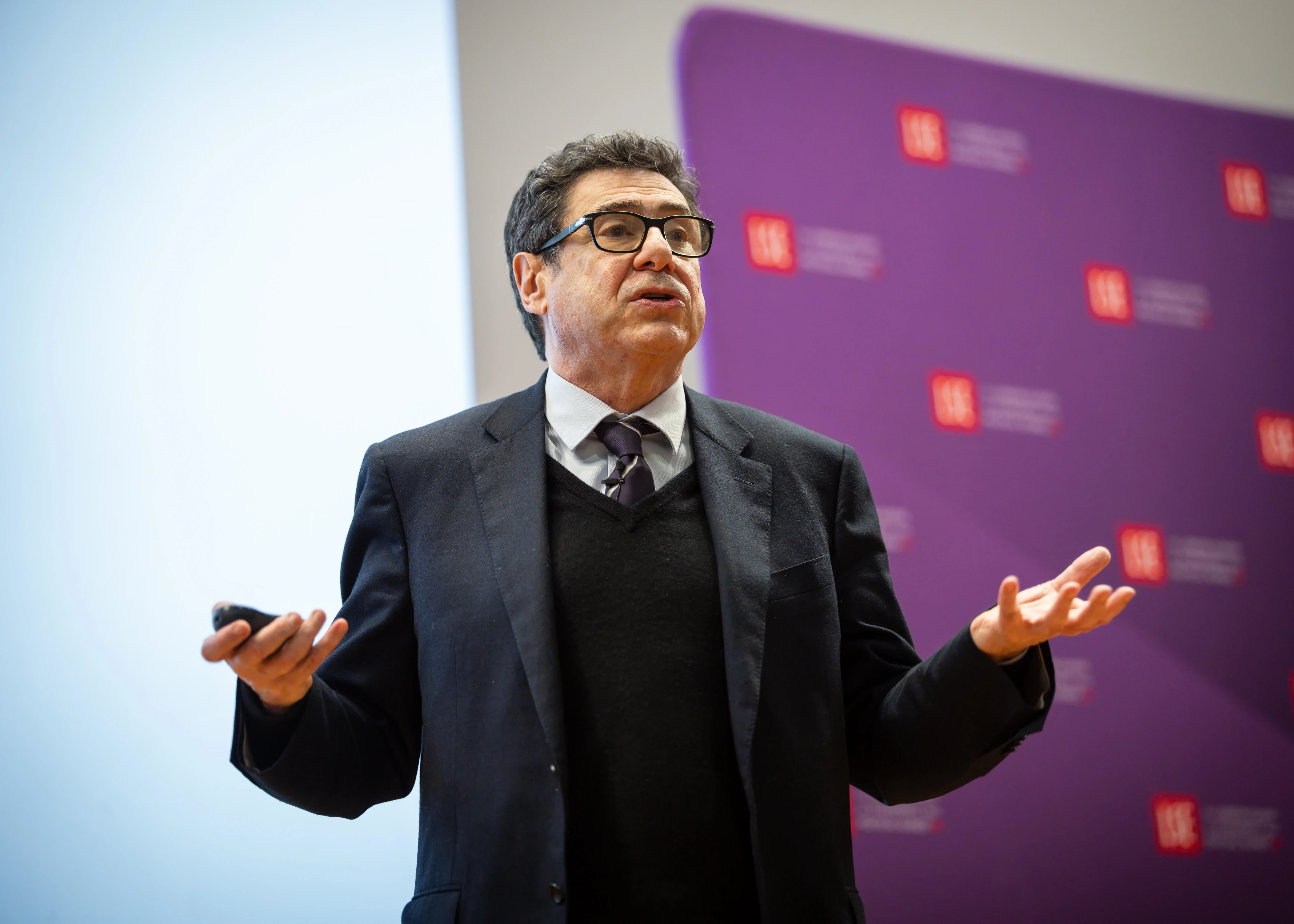
Philippe Aghion, a professor in LSE’s Department of Economics and joint recipient of the 2025 Nobel Memorial Prize in Economic Sciences, delivered a special public lecture at the university last week.
The event, chaired by LSE President and Vice Chancellor, Professor Larry Kramer, centred around the Schumpeterian growth paradigm, which conceptualises long-run growth as driven by cumulative processes of innovation. During the event, Aghion examined how this framework can be used to interpret contemporary issues in Europe, the growth of artificial intelligence as well as rethink capitalism.
During his speech, Aghion explored the concept of ‘creative destruction’- a notion that new innovations displace existing technologies. According to Aghion, “where you have growth, is where you have creative destruction”. However, he emphasised that this process is a double-edged sword: in the absence of appropriate policies, innovation can result in secular stagnation and the emergence of a middle‑income trap.
Elaborating on these dynamics, he explained that in a world characterised by technological leaders and followers, widening gaps between these two groups can impede the growth prospects of the latter. Faced with such disparities, follower economies may remain discouraged from transitioning from ‘imitation’ to ‘innovation’, leaving them perpetually trapped in a cycle of catchup.
The growth of AI and structural shifts in Europe
Aghion went on to note that these issues - having been at the fore of debate in recent history - are now more relevant than ever in light of the rapid growth of artificial intelligence and structural shifts within European economies. He critiqued the continents’ comparatively slow adoption of successive technological revolutions, pointing to a relative lack of innovation even during the IT revolution (in contrast to competitors in the US).
"In the US, you have creative destruction, you have new firms coming in. In Europe, you have the same incumbents,” he observed, attributing this state of affairs to a range of structural constraints, including risk aversion, the absence of a truly integrated market for capital and services, limited ecosystems that tolerate failure, and fragmented regulatory frameworks. He further noted that while “ideas are harder to find in each field, but not overall”, these constraints are likely to continue limiting competition and the capacity of artificial intelligence to boost productivity growth.
The Schumpeterian model and capitalism
The lecture then moved on to using the Schumpeterian model to reconsider capitalism, with Aghion framing this as an attempt to reconcile the innovation‑driven US model with the more protective European approach. “Some people think it’s an either/or”, he said, underscoring the need for policies that promote ‘flexcurity’ - a labour market strategy combining flexibility for employers to hire/fire with strong social security for employees - and education (since higher earning parents are able to better transmit knowledge and inspiration to innovate).
Highlighting the “lost Einsteins” phenomenon, Aghion argued that social and economic backgrounds continue to constrain innovative potential. Taken together, these policies promote creative destruction and social protection, ultimately allowing innovation and social mobility.
Towards the end of the lecture, Aghion warned that insufficient competition and a lack of policy reform, particularly in the face of rapid advances in AI, could lead to stagnation, constraining both employment growth and productivity gains crucial for European recovery.
As he cautioned, “We have a competition problem in AI…AI has big growth potential, but institutions may not adapt particular competition policies”. He further emphasised the importance of strong institutions that combine high‑quality education with flexicurity in labour markets in order to fully harness AI’s potential. As he concluded, "AI can be one way whereby European growth can resume but we need to have those same policies - competition, education, flexicurity -to take the maximum advantage of the AI revolution."
Watch a recording of Professor Aghion’s lecture.
What is the Schumpeterian paradigm?
-Founded by Joseph Schumpeter and later pioneered by Philippe Aghion and fellow economist and Nobel laureate Peter Howitt, the Schumpeterian paradigm is used to analyse the design of growth policies and the role of the state in the growth process.
-It posits that long-term economic growth is driven by innovation and ‘creative destruction’ and emphasises that new technologies replace old ones, creating competition between incumbents and entrants.
-Central to this paradigm is the idea that innovations result from entrepreneurial activities and entrepreneurs respond to the economic incentives (positive or negative) that result from economic policies and economic institutions.