5 min read
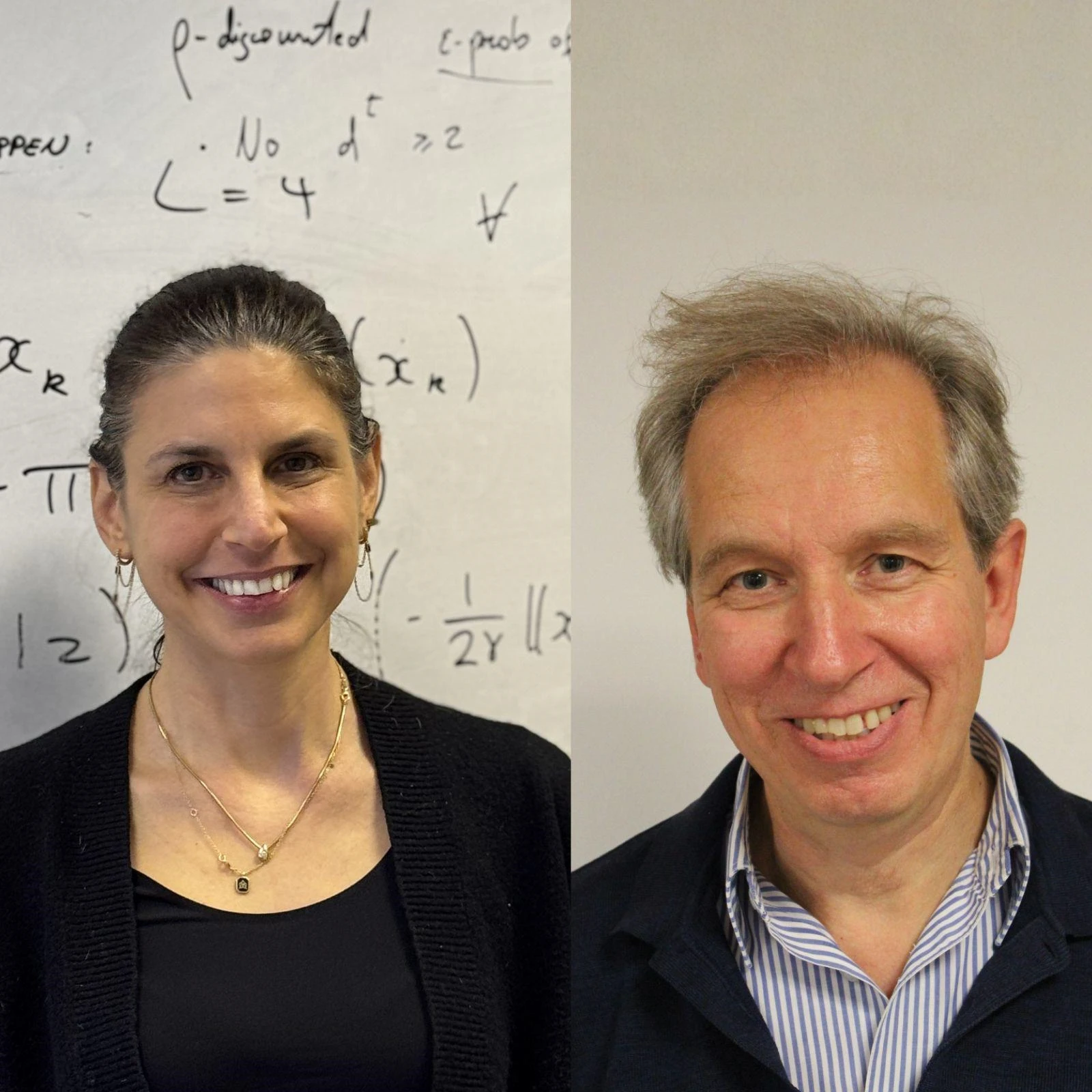
We sat down with Dr Galit Ashkenazi-Golan and Professor Bernhard von Stengel to explore how ME206: Mastering Strategy with Game Theory at LSE Summer School equips students with the tools to make optimal decisions in complex, interactive situations. From business negotiations and policy design to AI and technology, the course reveals the logic behind strategic behaviour.
What problem does your course aim to address?
The course addresses a fundamental challenge that students face across all disciplines: how to make optimal decisions when outcomes depend not only on your own choices but on the actions of others. Whether negotiating in business, designing public policy, or navigating everyday social interactions, success requires the ability to anticipate and influence others’ behavior. However, most people lack a systematic framework for this strategic thinking – they rely on intuition, which can lead to suboptimal outcomes or costly mistakes.
Game theory provides this missing framework. The course teaches students to identify the key elements of any strategic situation – the players, their available actions, their information, and their preferences – and to analyse how rational individuals will behave when their interests conflict or align. Through this systematic approach, students learn to avoid common strategic errors, recognise when cooperation can emerge from self-interest, identify when unpredictability becomes optimal, and understand mechanisms that align individual incentives with collective goals.
How does this course fit within the wider context of mathematics and research methods?
Game theory sits at the intersection of mathematics, economics, and the social sciences. Mathematically, it extends optimisation theory to multi-agent settings where the optimal choice depends on what others are doing.
As a research method, game theory provides a modeling framework used across disciplines. Economists use it to analyse markets and competition; political scientists apply it to voting systems and international relations; computer scientists employ it in algorithm design and AI; biologists use evolutionary game theory to study animal behavior. The course introduces students to this mathematical toolkit while emphasising conceptual understanding over technical proofs, making it accessible to students from diverse backgrounds.
How can students who take this course apply it in their future career?
The applications span virtually every professional domain. In business, graduates will recognise strategic interactions in pricing decisions, negotiations, partnership formation, and competitive positioning. They’ll understand why certain market structures lead to particular outcomes and how to design contracts that align incentives. In consulting and management, they’ll diagnose why organisations face collective action problems and recommend institutional designs that foster cooperation.
In technology and AI, the course prepares students for designing multi-agent systems, understanding algorithmic game theory, and anticipating how machine learning agents interact strategically. In policy and government, students will apply game theory to regulation design, voting systems, and international negotiations – understanding, for instance, why Brexit negotiations unfolded as they did. In law, they’ll better analyse litigation strategies, plea bargaining, and contract design.
Perhaps most importantly, the course teaches a transferable skill: disciplined strategic thinking. Whether students become entrepreneurs, policy analysts, product managers, or researchers, they’ll possess frameworks for analysing any situation where success depends on understanding and influencing others’ choices.
Could you please describe the practical components of the course and how students will engage in hands-on learning in the classroom?
The course emphasises active learning through iconic examples, case analysis, and interactive problem-solving. Each lesson introduces concepts through concrete scenarios that students work through in class.
The course includes tutorials where students work in small groups on problem sets and apply concepts to new situations, and present their analysis. These sessions emphasise strategic reasoning and argumentation, and help students develop the intuition needed to recognise game-theoretic structures in contexts that they will encounter professionally.
What resources would you recommend to anyone interested in taking this course?
The primary text is von Stengel’s ‘Game Theory Basics’ (Cambridge University Press, 2021). Binmore’s ‘Game Theory: A Very Short Introduction’ provides an excellent non-technical overview, while Dixit and Nalebuff’s ‘Thinking Strategically’ offers engaging real-world applications. Turocy and von Stengel’s encyclopedia entry on game theory covers the field’s foundations and methods.
Beyond textbooks, Professor von Stengel’s public lectures are valuable resources. His ‘Game Theory and Politics’ lecture (42,000+ YouTube views) demonstrates how game-theoretic concepts apply to real-world political situations. The adapted lecture notes provided in the course synthesise these materials and include numerous contemporary examples.
What is the most exciting thing students will learn in the classroom?
Students are consistently surprised by counterintuitive insights that game theory reveals. They discover that adding infrastructure can worsen traffic congestion (the Braess Paradox), that appearing slightly ‘irrational’ can be strategically beneficial, that sequential decision-making sometimes requires committing to threats you’d never want to carry out, and that optimal play often requires deliberate unpredictability.
Perhaps most exciting is learning how conflicts can be transformed through clever mechanism design or repeated interaction. The moment when students see that changing the “rules of the game” can fundamentally transform incentives and outcomes often represents a genuine intellectual breakthrough that reshapes how they view social, economic, and political interactions.

Dr Galit Ashkenazi-Golan
Assistant Professor, Department of Mathematics
Galit joined LSE in 2021 as an Assistant Professor. Prior to this, she was a research affiliate in the School of Mathematical Sciences of Tel-Aviv University. Her research focus is in Game Theory, the mathematical modelling of strategic interactions with particular interest in dynamic games (such as repeated games, stochastic games, or Borel Games), and often in the effect that information has on the equilibrium of a game.

Professor Bernhard von Stengel
Professor, Department of Mathematics
Having held postdoctoral positions at Berkeley and ETH Zurich, Bernhard joined the Department of Mathematics at LSE in 1998. He is now the Head of Department and a Professor of Mathematics at LSE. His main research is on mathematical and computational questions of game theory, in particular the structure and computation of equilibria in games.