BEGIN:VCALENDAR
VERSION:2.0
PRODID:-//hacksw/handcal//NONSGML v1.0//EN
CALSCALE:GREGORIAN
BEGIN:VTIMEZONE
TZID:Europe/London
BEGIN:STANDARD
TZNAME:GMT
DTSTART:19710101T020000
TZOFFSETFROM:+0100
TZOFFSETTO:+0000
RRULE:FREQ=YEARLY;BYMONTH=10;BYDAY=-1SU
END:STANDARD
BEGIN:DAYLIGHT
TZNAME:BST
DTSTART:19710101T010000
TZOFFSETFROM:+0000
TZOFFSETTO:+0100
RRULE:FREQ=YEARLY;BYMONTH=3;BYDAY=-1SU
END:DAYLIGHT
END:VTIMEZONE
BEGIN:VEVENT
DTEND;TZID=Europe/London:20160913T200000
UID:https://www.lse.ac.uk/granthaminstitute/?post_type=event&p=19496
DTSTAMP;TZID=Europe/London:20261003T222513Z
LOCATION:London School of Economics and Political Science\, Clement House\, Room CLM.2.02\, 99 Aldwych\, London\, WC2B 4JF
DESCRIPTION:LSE Deparment of Government and Grantham Research Institute public lecture\, introduced and chaired by Dr Kai Spiekermann
Attendance at this event is by registration only\, if you would like to attend please register here.
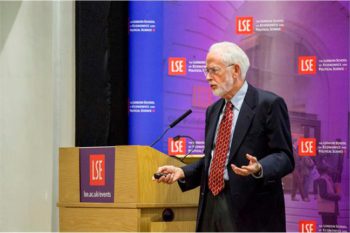 How great is the risk of a climate catastrophe\, and what should we do about it? The likelihood and possible impact of a catastrophic climate outcome is what drives the social cost of carbon (SCC)\, and thus the case for a stringent climate policy. But what is that likelihood\, and what kinds of outcomes might occur? Might the impact of a catastrophic climate outcome be limited to a sharp reduction in GDP and consumption (as most climate models assume)\, or might the impact also include the deaths of large numbers of people? The answers to these questions are necessarily speculative\, but we must address them. To complicate matters\, there are other potential catastrophes that we must also worry about\, such as nuclear or bioterrorism\, or the spread of a “mega-virus.” I discuss the policy implications of these threats\, and consider how we might respond to the risk of climate – and other – catastrophes.
Professor Robert
S.
Pindyck
is
the
Bank
of
Tokyo‐Mitsubishi
Professor
of
Economics
and
Finance
in
the
Sloan
School
of
Management
at
MIT.
He
is
also
a
Research
Associate
of
the
National
Bureau
of
Economic
Research
and
a
Fellow
of
the
Econometric
Society\,
and
he
has
been
a
Visiting
Professor
at
Tel‐Aviv
University\,
Harvard
University\,
and
Columbia
University.
Professor Pindyck's
research
and
writing
have
covered
topics
in
microeconomics
and
industrial
organization\,
the
behaviour
of
resource
and
commodity
markets\,
financial
markets\,
capital investment
decisions\,
and
econometric
modelling.
His
recent
work
in
economics
and
finance
has
examined
the
determinants
of
market
structure
and
market
power\,
the
dynamics
of
commodity spot
and
futures
markets\,
criteria
for
investing
in
risky
projects\,
the
economics
of
R&D
and
the value
of
patents\,
environmental
policy\,
and
the
economic
and
policy
implications
of
global catastrophic events.
Oversubscribe policy
Admission is on a first-come-first-served basis for those registered. Not everyone who registers attends\, so\, to ensure a full house\, registration is oversubscribed. Please ensure you arrive at least 15 minutes before the start time to avoid disappointment.
Accessibility
If you are planning to attend this event and would like details on how to get here and what time to arrive\, as well as on accessibility and special requirements\, please refer to LSE Events FAQ. LSE aims to ensure that people have equal access to these public events\, but please contact the events organiser as far as possible in advance if you have any access requirements so that arrangements\, where possible\, can be made. If the event is ticketed\, please ensure you get in touch in advance of the ticket release date.
WIFI Access
LSE has now introduced wireless for guests and visitors in association with ‘The Cloud’\, also in use at many other locations across the UK. If you are on campus visiting for the day or attending a conference or event\, you can connect your device to wireless. See more information and create an account at Join the Cloud.
Visitors from other participating institutions are encouraged to use eduroam. If you are having trouble connecting to eduroam\, please contact your home institution for assistance.
The Cloud is only intended for guest and visitor access to wifi. Existing LSE staff and students are encouraged to use eduroam instead.
URL;VALUE=URI:https://www.lse.ac.uk/granthaminstitute/events/public-lecture-climate-and-other-catastrophes/
SUMMARY:Public lecture | Climate (and other) catastrophes
DTSTART;TZID=Europe/London:20160913T183000
END:VEVENT
END:VCALENDAR
How great is the risk of a climate catastrophe\, and what should we do about it? The likelihood and possible impact of a catastrophic climate outcome is what drives the social cost of carbon (SCC)\, and thus the case for a stringent climate policy. But what is that likelihood\, and what kinds of outcomes might occur? Might the impact of a catastrophic climate outcome be limited to a sharp reduction in GDP and consumption (as most climate models assume)\, or might the impact also include the deaths of large numbers of people? The answers to these questions are necessarily speculative\, but we must address them. To complicate matters\, there are other potential catastrophes that we must also worry about\, such as nuclear or bioterrorism\, or the spread of a “mega-virus.” I discuss the policy implications of these threats\, and consider how we might respond to the risk of climate – and other – catastrophes.
Professor Robert
S.
Pindyck
is
the
Bank
of
Tokyo‐Mitsubishi
Professor
of
Economics
and
Finance
in
the
Sloan
School
of
Management
at
MIT.
He
is
also
a
Research
Associate
of
the
National
Bureau
of
Economic
Research
and
a
Fellow
of
the
Econometric
Society\,
and
he
has
been
a
Visiting
Professor
at
Tel‐Aviv
University\,
Harvard
University\,
and
Columbia
University.
Professor Pindyck's
research
and
writing
have
covered
topics
in
microeconomics
and
industrial
organization\,
the
behaviour
of
resource
and
commodity
markets\,
financial
markets\,
capital investment
decisions\,
and
econometric
modelling.
His
recent
work
in
economics
and
finance
has
examined
the
determinants
of
market
structure
and
market
power\,
the
dynamics
of
commodity spot
and
futures
markets\,
criteria
for
investing
in
risky
projects\,
the
economics
of
R&D
and
the value
of
patents\,
environmental
policy\,
and
the
economic
and
policy
implications
of
global catastrophic events.
Oversubscribe policy
Admission is on a first-come-first-served basis for those registered. Not everyone who registers attends\, so\, to ensure a full house\, registration is oversubscribed. Please ensure you arrive at least 15 minutes before the start time to avoid disappointment.
Accessibility
If you are planning to attend this event and would like details on how to get here and what time to arrive\, as well as on accessibility and special requirements\, please refer to LSE Events FAQ. LSE aims to ensure that people have equal access to these public events\, but please contact the events organiser as far as possible in advance if you have any access requirements so that arrangements\, where possible\, can be made. If the event is ticketed\, please ensure you get in touch in advance of the ticket release date.
WIFI Access
LSE has now introduced wireless for guests and visitors in association with ‘The Cloud’\, also in use at many other locations across the UK. If you are on campus visiting for the day or attending a conference or event\, you can connect your device to wireless. See more information and create an account at Join the Cloud.
Visitors from other participating institutions are encouraged to use eduroam. If you are having trouble connecting to eduroam\, please contact your home institution for assistance.
The Cloud is only intended for guest and visitor access to wifi. Existing LSE staff and students are encouraged to use eduroam instead.
URL;VALUE=URI:https://www.lse.ac.uk/granthaminstitute/events/public-lecture-climate-and-other-catastrophes/
SUMMARY:Public lecture | Climate (and other) catastrophes
DTSTART;TZID=Europe/London:20160913T183000
END:VEVENT
END:VCALENDAR